The Event
The Anthracite Region in 1902
By the turn of the century, anthracite coal heated most homes and businesses in the eastern United States. The mines that produced it stretched across six counties in northeastern Pennsylvania, with Lackawanna County and Scranton at the center of District 1, the northernmost of three mining districts. The United Mine Workers of America had won small concessions in a shorter strike in 1900, and by January 1902 the union counted more than 78,000 members across the three anthracite districts.
The mine operators controlled nearly every aspect of life in the coalfields. Workers bought goods at company stores, lived in company housing, and had no way to verify that the coal they loaded was weighed honestly. Wages had barely moved in years. The operators refused repeated attempts by UMWA president John Mitchell to open negotiations in early 1902.
The Strike Begins
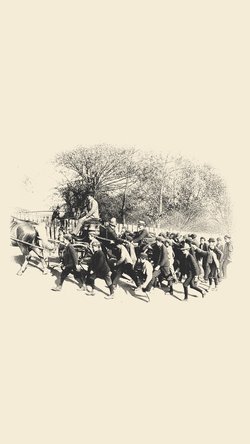
On May 12, 1902, miners voted in Scranton to walk off the job. Within the first week, more than 110,000 men left the mines. By the end of May, roughly 147,000 anthracite workers had joined the stoppage across Lackawanna, Luzerne, Schuylkill, Carbon, Northumberland, and Columbia counties.
The strikers’ demands were specific: a 20 percent wage increase, an eight-hour workday, the right to elect their own checkweighmen to verify tonnage, formal grievance procedures, and union recognition. Mitchell kept discipline tight. He urged miners to avoid violence and stay visible in their communities.
The Operators Dig In
The mine operators, led by George F. Baer of the Philadelphia and Reading Railway, refused all negotiation. Baer served as the chief spokesman for the coal companies and railroads that controlled the anthracite fields. He dismissed the strikers publicly and enlisted roughly 5,000 Coal and Iron Police to guard mine properties and escort strikebreakers.
During the summer, Baer wrote a letter to a citizen who had urged him to settle. In it, he declared that God had entrusted the country’s property to Christian men of business, not to union agitators. The letter leaked to the press and became known as the “divine right” letter. Public opinion, already sympathetic to the miners, turned sharply against the operators.
Violence in the Coalfields
Scattered violence broke out as the strike wore on. On July 2, Coal and Iron Police killed a man during a confrontation. On July 30, street fighting erupted in Shenandoah when strikers clashed with police and non-union workers. Joseph Beddall, a striker, was killed. The governor responded by sending the entire Pennsylvania National Guard into the coalfields.
Mitchell condemned the violence and continued to press for peaceful resolution. The presence of thousands of guardsmen and Coal and Iron Police did not break the strike. The mines stayed shut.
A National Crisis
As summer turned to fall, the strike became a national emergency. Anthracite heated homes, schools, hospitals, and factories throughout the Northeast. With winter approaching and coal stockpiles dwindling, prices spiked. Coal that sold for five dollars a ton in May reached fourteen dollars by September. Newspapers reported families in New York and Boston burning wood furniture to stay warm.
Businesses that depended on coal fuel began laying off workers. Governors from coal-consuming states pressured President Theodore Roosevelt to act. Roosevelt, barely a year into office after William McKinley’s assassination, faced a crisis with no clear precedent. No president had ever intervened in a labor dispute on behalf of workers.
Roosevelt Steps In
On October 3, 1902, Roosevelt convened a conference at the White House. He invited Mitchell and the UMWA leadership alongside Baer and the mine operators. Mitchell offered to submit all disputes to an independent arbitration panel and abide by its decision. The operators refused. Baer demanded that Roosevelt use federal troops to break the strike, as previous presidents had done in the Pullman Strike of 1894.
Roosevelt was furious. He privately told advisors he would order the Army to seize and operate the mines if the operators continued to refuse arbitration. The threat was legally questionable, but Roosevelt made clear he was willing to act.
The Morgan Compromise
Behind the scenes, Secretary of War Elihu Root traveled to New York on October 11 to meet with J.P. Morgan, the financier who controlled much of the capital behind the coal operators. Over several days, Root and Morgan worked out a compromise. The operators would accept a presidential commission to arbitrate the dispute if the commission’s membership met their specifications.
Roosevelt appointed a seven-member Anthracite Coal Strike Commission on October 16. On October 23, after 163 days, the strike ended. Miners returned to work with the understanding that the commission’s ruling would be binding.
Hearings in Scranton
The commission held its main hearings at the Lackawanna County Courthouse at 200 North Washington Avenue in Scranton, beginning November 14, 1902. Over the next three months, 558 witnesses testified. The record filled 50 volumes and ran to 10,047 pages.
Clarence Darrow served as lead attorney for the UMWA. He called miners, breaker boys, and their families to testify about wages, hours, and working conditions. Children as young as nine described sorting coal in the breakers for pennies a day. Darrow made child labor a central issue of the proceedings, questioning whether a civilized society could tolerate sending boys into the breakers instead of schools.
From February 9 to 13, 1903, Darrow delivered his closing argument. He spoke for days, walking the commissioners through the exposed pay stubs, injury records, and testimony of hundreds of workers.
The Commission’s Award
On March 21, 1903, the Anthracite Coal Strike Commission issued its final ruling. Miners received a 10 percent wage increase, a reduction from ten-hour to nine-hour workdays, and the right to elect their own checkweighmen. The commission established a three-person Board of Conciliation to handle future grievances. It did not grant formal union recognition, but the UMWA’s role in the proceedings amounted to implicit acknowledgment.
The award fell short of what the miners had demanded. They had asked for 20 percent and an eight-hour day. But the commission’s ruling set a precedent: the federal government had intervened in a labor dispute not to crush the strikers but to compel both sides to submit to arbitration.
The Mitchell Monument
On May 30, 1924, Scranton dedicated a monument to John Mitchell at Courthouse Square, steps from where the arbitration hearings had taken place twenty-two years earlier. Mitchell had died in 1919 at forty-nine. The bronze statue depicted him standing upright, and it became a gathering point for labor events in the city for decades. The monument still stands in Courthouse Square.
Timeline of Events
1902-05-12
Miners vote in Scranton to strike; over 110,000 walk out within the first week
1902-06-02
Maintenance employees walk out, escalating the shutdown
1902-07-30
Street fighting in Shenandoah; Joseph Beddall killed
1902-10-03
President Roosevelt convenes White House conference with operators and union
1902-10-23
Strike ends after 163 days; miners return to work pending arbitration
1902-11-14
Arbitration hearings begin at Lackawanna County Courthouse in Scranton
1903-02-13
Clarence Darrow delivers closing argument for the miners
1903-03-21
Anthracite Coal Strike Commission issues final award
Sources & Further Reading
- The Coal Strike of 1902: Turning Point in U.S. Policy , Jonathan Grossman (1971)
- The 1902 Anthracite Strike: Causes and Consequences , University of Scranton (2022)
- The Anthracite Coal Strike , Clarence Darrow Digital Collection, University of Minnesota (2023)
- Pennsylvania anthracite coal workers strike, 1902 , Global Nonviolent Action Database, Swarthmore College (2011)
- The Greatest Strike Ever , Pennsylvania Center for the Book, Penn State (2020)