The Event
The Colliery
Avondale Colliery sat in Plymouth Township, Luzerne County, about fifteen miles southwest of Scranton. The mine operated through a single shaft, the Steuben Shaft, sunk more than 300 feet to the working coal vein. J.C. Phelps of Wilkes-Barre had leased the property from Henderson Gaylord and William C. Reynolds in June 1863. Management passed to the Steuben Coal Company in January 1866, which merged the following year with the Nanticoke Coal & Iron Company.
The Delaware, Lackawanna and Western Railroad, headquartered in Scranton, controlled the operation through this subsidiary chain. In 1867, the company erected a coal breaker directly over the mouth of the shaft. England had already banned this practice. The breaker’s wooden frame sat atop the only way in or out of the mine.
A ventilating furnace at the bottom of the shaft drew air through the workings. The shaft itself was lined with wooden lattice. Every element of the design concentrated fire risk at the mine’s sole exit.
September 6, 1869
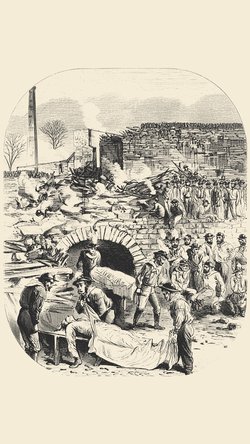
Around 10:00 on the morning of September 6, sparks from the ventilating furnace caught the wooden lattice lining the shaft. Alexander Weir, the mine engineer, was the first to spot the flames. Fire rushed upward through the shaft and ignited the breaker overhead.
The breaker burned and collapsed into the shaft opening, sealing it with flaming debris. Below, 108 miners and boys had no second exit. Among them were five boys between twelve and seventeen years old who worked as door boys and mule drivers.
Word spread through the surrounding towns. By afternoon, thousands of people had gathered at the colliery. Fire engines arrived from Scranton, Wilkes-Barre, and Kingston. Rescuers worked to clear the burning wreckage from the shaft mouth, but the fire had consumed the headframe and hoisting apparatus.
The Rescue Attempts
By 6:00 PM, workers had cleared enough debris to lower a dog and a lit lantern into the shaft on a rope. The dog survived the descent and came back alive. The lantern went out. No breathable air remained below.
Two men volunteered to go down. Thomas W. Williams and David Jones were lowered into the shaft. Neither returned alive. Carbon monoxide and oxygen deprivation killed them before they reached the bottom. Their deaths brought the toll to 110.
Two full days passed before rescue teams could descend safely. When they finally reached the workings on September 8, they found the miners’ bodies in clusters. Many had built crude barriers of timbers, clothing, and coal dust, sealing themselves into side passages to conserve breathable air. The barriers had bought them hours, not survival.
The Dead
Of the 110 victims, 69 were of Welsh heritage. Many had immigrated to the anthracite region within the previous decade, drawn by the same coal seams that killed them. The disaster left 72 widows and 158 fatherless children in Plymouth Township and the surrounding communities.
On September 9, a mass funeral procession carried the dead through the streets. Sixty-one of the victims were buried at Washburn Street Cemetery in Scranton’s Hyde Park neighborhood, where a large Welsh mining community had settled. The remaining victims were interred in cemeteries across Luzerne County.
Siney at the Grave
John Siney, president of the Workingmen’s Benevolent Association, arrived at Avondale as the bodies were being recovered. Standing among thousands of mourners, he delivered a speech that reframed the disaster as a consequence of operator negligence rather than an act of fate.
“Men, if you must die with your boots on, die for your families, your homes, your country,” Siney told the crowd. “But. . . . Let us pledge ourselves, on the altar of the dead, that we will use all lawful means to bring about reforms in the mining laws.”
Among those who heard the speech, or heard accounts of it in the days that followed, was a young Scranton machinist named Terence V. Powderly. He later cited the Avondale disaster and Siney’s words as formative experiences. Powderly went on to lead the Knights of Labor and serve as mayor of Scranton from 1878 to 1884.
The Laws That Followed
Before Avondale, Pennsylvania had no mine safety statutes. The single-shaft design that killed 110 people was legal. No law required a second exit, forced ventilation, or state inspection.
In 1869, months after the disaster, the legislature passed its first mine safety act. The law was narrow. It applied only to Schuylkill County and required basic ventilation and inspection standards.
In 1870, Pennsylvania passed the Anthracite Mine Ventilation Law. This one covered the entire anthracite region. It mandated that every mine maintain at least two separate openings for ventilation and escape. State mine inspectors received authority to enter and examine any operation. In 1877, the legislature extended similar protections to bituminous coal mines in western Pennsylvania.
The federal government took longer. Congress did not pass its first mine safety statute until 1891, twenty-two years after the fire at Avondale.
The Marker
On September 1, 1994, the Pennsylvania Historical and Museum Commission dedicated a historical marker at the site of the Avondale Colliery in Plymouth Township. The marker stands 125 years after the fire, on ground where 110 men and boys died because their mine had one way out and a wooden building on top of it.
Timeline of Events
1863-06-13
J.C. Phelps of Wilkes-Barre leases the mine from Henderson Gaylord, William C. Reynolds, and others
1866-01
Colliery management transferred to Steuben Coal Company
1867
Steuben Coal merges with Nanticoke Coal & Iron Company; new breaker erected directly over the shaft
1869-08
Miners at Avondale engage in a seven-day strike against the DL&W Railroad
1869-09-06
Fire breaks out in the shaft; 110 killed including 5 boys aged 12-17
1869-09-09
Mass funeral held; 61 victims buried at Washburn Street Cemetery in Scranton's Hyde Park
1870
Pennsylvania passes the Anthracite Mine Ventilation Law, requiring two exits for all mines
1994-09-01
Pennsylvania historical marker dedicated at the disaster site
Sources & Further Reading
- Avondale Mine disaster , Wikipedia (2024)
- Avondale Mine Disaster , ExplorePAHistory.com (2011)
- Avondale Mine Disaster , Mining History Association (2019)
- Benchmarks: September 6, 1869: Pennsylvania's Avondale Coal Mine Fire Kills 110, Igniting Reform , EARTH Magazine / American Geosciences Institute (2019)
- Mining Legislation , Pennsylvania Department of Environmental Protection (2020)