The Event
Thomas Dickson’s Path to the Lackawanna Valley
Thomas Dickson was born in 1824 in Leeds, England, to a family of Scottish parentage. In 1835, the Dicksons emigrated to Nova Scotia, then moved the following year to Carbondale, Pennsylvania, where eleven-year-old Thomas found work as a mule driver for the Delaware & Hudson Railroad. He grew up in the coal fields, learning the machinery that kept the mines running.
By the mid-1850s, Dickson had assembled a partnership with his brothers John and George and two associates, Maurice and Charles Wurts. In 1855, the five men opened a small machine shop and foundry in Carbondale under the name Dickson & Co. Their early work centered on stationary steam engines and boilers for the Delaware & Hudson Canal Company’s coal operations.
George Scranton’s Invitation
The Dickson brothers might have stayed in Carbondale, building engines for coal mines, had George Scranton not intervened. Scranton, whose iron works and railroad had already transformed the hamlet of Slocum’s Hollow into a booming city, saw the value of a local machine shop that could serve the growing industrial base. In 1856, he persuaded Dickson & Co. to relocate to the newly incorporated city of Scranton.
The partners established their works on Penn Avenue at Vine Street, close to the Lackawanna Iron and Coal Company’s furnaces and the Delaware, Lackawanna and Western Railroad’s yards. A second facility, the Dickson Works, was later built at 225 Vine Street. The site placed them at the intersection of iron, coal, and rail, the three industries that defined Scranton in the 1850s.
From Boilers to Locomotives
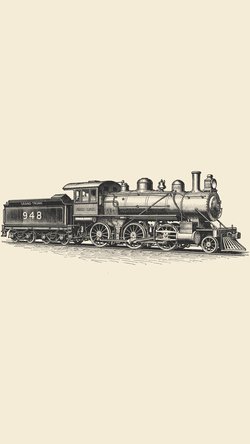
For the first six years, Dickson & Co. produced stationary steam engines, boilers, and mining equipment. The transition to locomotive building came in March 1862, when the company completed its first steam locomotive for the Delaware & Hudson Canal Company. That same year, the partners re-incorporated as the Dickson Manufacturing Company and purchased the Cliff Locomotive Works at 230-232 Cliff Street from Cooke & Co.
The Cliff Street facility became the locomotive shop. Production started slowly, at five or six engines per year through the early 1860s, but the company’s product line expanded rapidly. Dickson manufactured steam locomotives, blowing engines, mine cable hoists, railroad cars, and stationary steam engines. In 1864, the company opened a car plant for railroad car manufacturing.
Thomas Dickson Moves On
Thomas Dickson’s ambitions outgrew the manufacturing company he had founded. In 1869, he resigned from Dickson Manufacturing to accept the presidency of the Delaware & Hudson Railroad, a position he held until his death in 1884. The company that bore his name continued under new leadership, though Thomas’s departure marked a turning point. The firm’s founder had gone from mule driver to railroad president in three decades.
Under the Dickson name, locomotive production accelerated through the early 1870s, rising from five or six units per year to five per month. The company completed its 100th locomotive in 1872. Dickson engines pulled freight and passengers across the northeastern coal fields, and the company began exporting locomotives to Costa Rica and South Africa.
Fire and Reconstruction
On a night in 1874, fire swept through the Cliff Works on Cliff Street, destroying much of the locomotive shop. The company rebuilt between 1875 and 1876, replacing the lost structures with a brick Machine Shop and Pattern Shop designed to resist future fires. The new Dickson Works building at 225 Vine Street went up in 1878, a three-story brick industrial structure that still stands. In 1882, the Penn Avenue machine shops were rebuilt as well, covering 29,000 square feet.
By 1890, the combined Dickson facilities covered six acres and employed more than 1,200 workers. The company occupied two main complexes: the Penn Avenue and Vine Street shops, where offices and general machine work were concentrated, and the Cliff Street works, where locomotive assembly continued.
The Boies Years
Henry Martyn Boies, Thomas Dickson’s son-in-law, served as president of Dickson Manufacturing from 1883 to 1887. Boies had married Thomas’s daughter Elizabeth and brought his own credentials to the role. A Yale graduate, he had founded the Moosic Powder Company and invented a gunpowder cartridge used in mining operations.
During his presidency, Boies developed a demountable steel-tired locomotive wheel at the Dickson works. In 1888, after leaving the presidency, he launched the Boies Steel Wheel Company to market the patented design. Thomas Dickson himself did not live to see any of this. He died on July 31, 1884, in Morristown, New Jersey, at the age of sixty.
Peak Production and Dissolution
Dickson Manufacturing completed its 1,000th locomotive in 1898, forty-two years after moving to Scranton. The company had established itself as one of the mid-Atlantic’s principal locomotive builders, with additional operations in Wilkes-Barre and an office in New York City.
The end came on June 24, 1901, when Dickson’s locomotive division merged with seven other firms to form the American Locomotive Company, known as ALCO. The remaining industrial machinery business was absorbed into the Allis-Chalmers Company. After nearly half a century, the Dickson Manufacturing Company ceased to exist as an independent entity.
ALCO continued operating the Scranton plant for eight more years, building 428 locomotives under its own name. The last engine rolled out of the former Dickson works in April 1909, bringing the total number of locomotives built at the site to 1,334. ALCO then closed the Scranton facility and consolidated production elsewhere.
What Remained
The Cliff Works at 230-232 Cliff Street passed through a series of occupants after ALCO departed. Silk mills operated there from 1912 to 1936, followed by the Williams Baking Company from 1936 to 1956, and furniture warehousing from 1956 to 1988. In 1999, the Lackawanna Heritage Valley Trolley Museum moved into the building, where it remains.
The Dickson Works at 225 Vine Street was listed on the National Register of Historic Places in 1979. The three-story brick building, constructed around 1878 to house the company’s mining equipment and boiler operations, is one of the few physical traces of an enterprise that once covered six acres and employed over a thousand workers. Dickson City, Pennsylvania, a borough adjoining Scranton, carries the founder’s name.
Timeline of Events
1855
Thomas Dickson, brothers John and George, and Maurice and Charles Wurts open a machine shop and foundry in Carbondale as Dickson & Co.
1856
George Scranton persuades Dickson & Co. to relocate to Scranton; works established on Penn Avenue at Vine Street
1862-03
First locomotive completed for Delaware & Hudson Canal Company
1862
Company re-incorporated as Dickson Manufacturing Company; purchases Cliff Locomotive Works on Cliff Street
1869
Thomas Dickson resigns to become president of Delaware & Hudson Railroad
1872
100th locomotive completed
1874
Major fire destroys much of the Cliff Works
1875
Cliff Works rebuilt with brick Machine Shop and Pattern Shop
1882
Penn Avenue machine shops rebuilt (29,000 square feet)
1884-07-31
Thomas Dickson dies in Morristown, New Jersey
1890
Shops cover six acres; more than 1,200 employees
1898
1,000th locomotive completed
1901-06-24
Locomotive division merges into American Locomotive Company (ALCO); industrial machinery absorbed by Allis-Chalmers
1909-04
ALCO closes former Dickson works in Scranton; last locomotive built
1979
Dickson Works at 225 Vine Street listed on National Register of Historic Places
Sources & Further Reading
- Dickson Manufacturing Company , Mid-Continent Railway Museum (2025)
- Dickson Manufacturing Company , CPTDB Wiki (2025)
- From Locomotives to Trolleys: The Remarkable History of 230-232 Cliff Street, Scranton, PA , NEPA Sports History (2025)
- The Scranton Story , Burton Folsom Jr. (1998)
- Penn Paper building added to National Register of Historic Places , Scranton Times-Tribune (2024)
- Dickson Manufacturing Company , DBpedia (2025)
- Presidents of the D&H , Bridge Line Historical Society (2025)
- Thomas Dickson (industrialist) , Wikipedia (2025)
- Dickson Manufacturing Company , Wikipedia (2025)
- Dickson City, Pennsylvania , Wikipedia (2025)