The Event
A System at Its Peak
The 1896 consolidation that merged five competing railways into a single Scranton Railway Company gave the city a transit network capable of reaching far beyond the downtown core. By 1907 the company owned 47.63 miles of outright track and operated over 81.55 miles total through a web of trackage rights and joint operations assembled over two decades. The system eventually covered 110 miles of track, with cars stopping every fifteen minutes on routes stretching from Green Ridge through downtown and out to the county towns. American Railways Company, a holding company, purchased the railway in 1905, and the fleet grew through the following decade. By 1912 trolleys carried 24 million passengers, and for that stretch of years the streetcar was simply how Scranton moved.
The Electromobiles
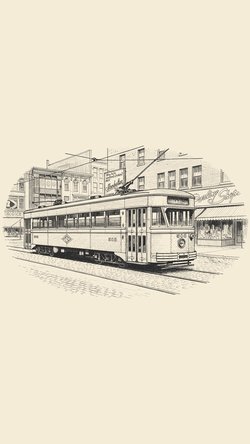
In 1929, with ridership still substantial though clearly past its peak, Scranton Railway bought ten lightweight cars from the Osgood Bradley Car Company of Worcester, Massachusetts, numbered 501 through 510 and marketed as Electromobiles. They went to work on the Green Ridge Suburban line, the same route the system had launched in 1886, and they stayed there for the rest of the railway’s life. A 1938 photograph shows car 505 at the end of that line, already nine years old, with no sign then that it would still be running when the line closed sixteen years later. The Electromobiles were the last rolling stock the company ever purchased.
Decline and Reorganization
The automobile and the motor bus reshaped the economics of electric transit through the 1920s. Long suburban routes that had extended the system’s reach into outlying communities became difficult to justify as riders shifted to private cars and bus lines appeared along the same corridors with lower infrastructure costs. The Scranton-to-Pittston route was abandoned in 1923, and other extensions followed as the company pulled back toward the denser corridors closer to downtown.
The company reorganized as the Scranton Transit Company in 1934 after years of route cuts. Conversion from electric to bus service continued through the 1930s and 1940s, line by line, until the Green Ridge Suburban route was among the last trolley operations left.
December 18, 1954
Motorman George Miller took the final run on December 18, 1954, operating one of the Electromobiles down Wyoming Avenue, along Spruce Street past the courthouse, and up Adams Avenue into Green Ridge, retracing the route of the system’s inaugural run in November 1886. When he brought the car back, sixty-eight years of electric streetcar service in Scranton ended. Pennsylvania’s first electric railway, open continuously since 1886, had made its last run, and buses took over the route the next morning.
What Remained
Scranton Transit burned the remaining fleet for scrap after the closure. All ten Electromobiles were destroyed except car 505, which Dr. Stanley Groman purchased, along with sweeper car 107, for his Rail City Museum in Sandy Pond, New York. The car moved to the Magee Transportation Museum in Bloomsburg in the mid-1960s, but Hurricane Agnes flooded the Magee facility in 1972 and broke up the collection. Car 505 ended up in a railway salvage yard in Burnham, Pennsylvania, where it sat for roughly twenty years before the Electric City Trolley Museum Association began a restoration effort. The car returned to Scranton in November 2012, fifty-eight years after its last run on the Green Ridge line.
Timeline of Events
1896
Five railways consolidate into Scranton Railway Company
1905
American Railways Company purchases the railway
1912
Ridership peaks at 24 million passengers
1923
Scranton-to-Pittston route abandoned as suburban ridership declines
1929
Scranton Railway purchases ten Electromobile cars from Osgood Bradley Car Company
1934
Company reorganizes as Scranton Transit Company
1954-12-18
Final trolley runs; motorman George Miller operates last car on Green Ridge route
1971-11-15
Transit workers strike over wage cuts; Scranton Transit halts operations permanently
1972
County of Lackawanna Transit System succeeds Scranton Transit
2012-11-15
Preserved car 505 departs for Electric City Trolley Museum in Scranton
Sources & Further Reading
- Scranton Railway , Wikipedia (2025)
- Electric Trolleys , Scranton History (2025)
- Project 505 , Electric City Trolley Museum Association (2025)
- Scranton 505 and Rockhill Trolley Museum , Rock Hill Car Projects (2012)
- Pennsylvania Trolley Museum Reference Guide , Pennsylvania Trolley Museum (2024)