The Event
The Hot Blast Innovation
The Lackawanna Valley’s transformation began with a New Jersey ironmaster named William Henry. On May 24, 1835, Henry achieved the first successful hot blast in American iron production at Oxford Furnace in Warren County, New Jersey. The technique pre-heated air before pumping it into the furnace, cutting production time and increasing output by nearly 40 percent.
Henry believed the Lackawanna Valley held greater promise. As early as 1838, he investigated the feasibility of establishing an anthracite-fueled blast furnace along Roaring Brook. The site offered abundant deposits of anthracite coal, limestone, and iron ore, with reliable water power from the brook itself. Henry lacked capital to develop the location himself.
Formation of Scrantons, Grant & Company
In 1840, Henry formed a partnership with his son-in-law Selden T. Scranton, Selden’s brother George W. Scranton, and Sanford Grant, a merchant and banker from Belvidere, New Jersey. Philip H. Mattes, a bank manager from Easton, Pennsylvania, also invested. Together, they raised approximately $20,000 and purchased 503 acres in the five-house hamlet called Slocum’s Hollow.
The Scranton brothers brought practical experience from Oxford Furnace, where they had both worked. George, born May 11, 1811, had moved to Belvidere in 1828 and worked as a teamster before entering the iron trade. Selden had served as Henry’s assistant at Oxford since 1834.
Early Failures
The partnership completed its first blast furnace in the early autumn of 1841. The initial smelting attempt failed. Problems plagued the operation: the furnace did not reach sufficient temperature, water ran too low in the creek to power the bellows, charge mixtures proved unsuccessful, and the tuyeres clogged repeatedly. The partners experimented with wood, charcoal, salt, and brimstone to intensify the heat, with no success.
A second effort also failed. The company faced collapse. The partners enlarged and multiplied the hot-air ovens, altered the machinery, and brought in John F. Davis, an ironmaker with experience in anthracite furnaces. His practical knowledge proved decisive.
On January 18, 1842, the furnace was successfully blown in. The first month of operation produced about two and a quarter tons of pig iron per day.
Financial Pressures
Success at the furnace did not guarantee business survival. The company remained financially precarious through the mid-1840s. Sanford Grant, facing the strain of competition and risk, sold his stock in November 1846 and returned to Belvidere, where he lived until his death in the 1880s.
Joseph H. Scranton, a cotton broker from Augusta, Georgia, and cousin to George and Selden, provided critical financing. His investment in 1846 saved the firm from bankruptcy. Joseph moved his family to the valley the following year and would later serve as company superintendent.
The company reorganized as Scrantons & Platt, with Joseph C. Platt replacing Grant. Platt operated the first company store.
The Erie Railroad Gamble
The company’s salvation came from an audacious contract. In 1846, the New York and Erie Railroad faced bankruptcy. The state of New York offered to release its $3 million claim if the line reached Binghamton within a specified deadline. The task seemed impossible because the company could only purchase the needed iron rails from England, and English suppliers hesitated to commit.
The Scrantons traveled to New York and persuaded the railroad’s board of directors to give their firm a contract for 12,000 tons of T-rails, each weighing 58 pounds per yard, to be delivered within two years. The firm had never produced such a product. No American ironworks had manufactured rails at commercial scale.
The same year, Congress passed the Walker Tariff, which reduced duties on imported iron from 50-80 percent to 30 percent. The tariff change threatened to flood American markets with cheaper English rails. The Scrantons had bet everything on domestic production just as import costs were falling.
Rolling the First Rails
Machinery was brought from Philadelphia and installed at the Scranton works. On July 23, 1847, the first T-rails were rolled. These were among the earliest rails produced in the United States, though the Montour Iron Works in Danville had rolled T-rails in October 1845.
Production ramped up quickly. The company soon employed more than 800 workers, predominantly Welsh, Irish, and German immigrants drawn to the valley by the promise of steady wages.
On December 27, 1848, just four days before the Erie Railroad’s charter would have expired, the Scrantons fulfilled their contract. The completed rail line connected New York to Binghamton. The Scrantons had delivered the impossible.
Building the Railroad
George Scranton recognized that the company needed better transportation links to its markets. Between 1850 and 1853, he surveyed and built two rail lines: the Lackawanna and Western Railroad, running northward to meet the Erie Railroad at Great Bend, Pennsylvania, and the Delaware and Cobbs Gap Railroad.
On March 11, 1853, the two lines consolidated as the Delaware, Lackawanna and Western Railroad. George Scranton served as its first president. The railroad gave the iron company direct access to markets in New York and beyond.
Incorporation as Lackawanna Iron and Coal
The same month, flush with success, the partners reorganized their ironworks under a special charter from the state. The new Lackawanna Iron and Coal Company was capitalized at $800,000, doubling the firm’s previous investment. Selden T. Scranton was elected president. Joseph H. Scranton became superintendent.
By 1854, the company’s assets had expanded to include three furnaces, steel-making puddling mills, a foundry, two blacksmith shops, two carpentry shops, a car shop, a sawmill, a grist mill, offices, a company store, a boarding house, a hotel, a tavern, 200 worker dwellings, iron ore mines, and coal mines.
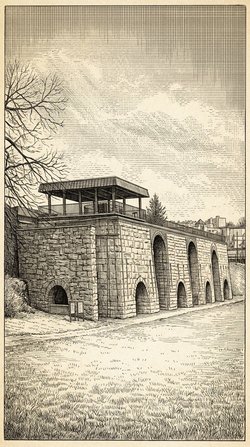
A fourth furnace was added by 1855, and a fifth by 1857. The four massive stone blast furnaces that survive today as a historic site were built between 1848 and 1857.
Largest in the Nation
Production scale grew throughout the 1850s and into the Civil War years. By 1854, anthracite accounted for 45 percent of all pig iron produced in the United States. The Lackawanna Valley had become the center of American iron production.
By 1865, Lackawanna Iron and Coal had achieved the largest iron production capacity in the United States. The company that had nearly failed in 1841 now dominated its industry.
A City Takes Shape
The company’s growth transformed the region beyond recognition. The village variously known as Deep Hollow, Slocum Hollow, Unionville, and Harrison gained a new name in 1850: Scrantonia. The following year, the “ia” was dropped, and the settlement incorporated as the borough of Scranton.
Population statistics tell the story of explosive growth. In 1850, Scranton had roughly 2,700 residents, and no one in the Lackawanna Valley was worth more than $10,000 according to the federal census. By 1860, population had reached 9,000. By 1870, it exceeded 35,000, and 33 families in Scranton alone were worth at least $100,000. One had become a millionaire.
Scranton was incorporated as a city in 1866. By 1878, it had become the seat of the newly formed Lackawanna County. By the late 1880s, Scranton had earned the title “Anthracite Capital of the World.”
George Scranton’s Later Years
George Scranton parlayed his industrial success into political office. He served as a Republican member of the U.S. House of Representatives from Pennsylvania’s 12th district from 1859 until his death. He built a fine mansion in the city bearing his name and amassed a personal fortune of $200,000.
He died on March 24, 1861, at age 49, just months after taking his seat in Congress. Selden and his brother Charles had left the company five years earlier to operate a blast furnace back at Oxford, New Jersey.
The Move to New York
By the turn of the century, economic pressures were mounting on the Scranton operation. The United Mine Workers had organized most workers at the coal and iron mines by 1897, and a successful 1900 strike won a 10 percent wage increase. Shipping costs for iron ore to Scranton rose, while rail connections to emerging western markets remained inadequate.
On February 14, 1902, the company reorganized as the Lackawanna Steel Company and began dismantling operations in Scranton. The new facility would be built in West Seneca, New York, near Buffalo, with easy access to Great Lakes shipping and the high-grade iron ores of Minnesota’s Mesabi Range. Stock worth $60 million was issued, with $20 million paying for construction of the new mill.
The new plant received its first shipment of iron ore on December 23, 1902. When the company moved, it stimulated the founding of the city of Lackawanna, New York.
Legacy
The Scranton furnaces fell silent after 62 years of operation. But the city the Scrantons built remained. A five-house hamlet had become one of Pennsylvania’s largest cities, with a population approaching 100,000 by 1900.
The four stone blast furnaces that survive today stand as monuments to the industrial gamble that created a city. The site has been managed by the Pennsylvania Historical and Museum Commission since 1971 and was added to the National Register of Historic Places in 1991. It remains part of the Pennsylvania Anthracite Heritage Museum complex.
The Lackawanna Steel Company itself survived until 1922, when Bethlehem Steel acquired it. The Lackawanna plant grew to employ over 20,000 workers by the 1940s, becoming the world’s largest steel factory. Bethlehem began downsizing operations in the 1970s, and by 1983, most operations had ceased. The closure devastated communities on both ends of the company’s history, but the name Scranton endured on the city the founders had built from nothing.
Timeline of Events
1835-05-24
William Henry achieves first successful hot blast at Oxford Furnace, New Jersey
1838
William Henry investigates Lackawanna Valley for anthracite iron production
1840
Scrantons, Grant & Company formed; partners purchase 503 acres in Slocum's Hollow
1841-10
First blast furnace completed; initial smelting attempts fail
1842-01-18
Furnace successfully blown in, producing 2.25 tons of pig iron per day
1846
Company secures 12,000-ton T-rail contract with New York and Erie Railroad
1846-11
Sanford Grant leaves; company reorganizes as Scrantons & Platt
1847-07-23
First T-rails rolled at Scranton works
1848-12-27
Erie Railroad contract fulfilled four days before charter deadline
1851
Slocum's Hollow renamed Scranton; incorporated as borough
1853-03-11
Company reorganizes as Lackawanna Iron and Coal Company with $800,000 capital
1865
Company achieves largest iron production capacity in the United States
1866
Scranton incorporated as a city
1902-02-14
Company reorganizes as Lackawanna Steel Company; operations relocate to New York
Sources & Further Reading
- The Scranton Story , Foundation for Economic Education (1998)
- Lackawanna Steel Company , Wikipedia (2025)
- George W. Scranton , Wikipedia (2025)
- Scranton Iron Furnaces , Wikipedia (2025)
- Scranton's Iron Furnace Historical Marker , Historical Marker Database (2025)
- Iron Furnaces , Pennsylvania Anthracite Heritage Museum (2025)
- Lackawanna Iron and Coal Company Furnaces , SAH Archipedia (2025)
- Scranton's Founding Father: George W. Scranton , Scranton History (2011)
- Local history: Lackawanna Iron & Coal leaves Scranton , Scranton Times-Tribune (2011)