The Event
The Site at Roaring Brook
William Henry had been looking at the Lackawanna Valley since 1838. A New Jersey ironmaster who ran the Oxford Furnace in Warren County, Henry had achieved the first successful hot blast in American iron production on May 24, 1835. The technique pre-heated air before pumping it into the furnace, cutting fuel costs and increasing output by nearly 40 percent. He believed the same method could work with Pennsylvania anthracite.
What drew Henry to Slocum Hollow was geology. Anthracite coal, iron ore, and limestone all outcropped within walking distance of Roaring Brook. The creek itself could power a waterwheel to drive the furnace bellows. In March 1840, Henry and his partners purchased 503 acres for $8,000. The settlement they bought into contained five houses, a schoolhouse, a gristmill, a sawmill, a cooper shop, and the Slocum family home.
Building the Furnace
Henry formed a partnership with his son-in-law Selden T. Scranton, Selden’s brother George W. Scranton, Sanford Grant of Belvidere, New Jersey, and Philipp Mattes, an Easton bank manager. They organized as Scranton, Grant & Company and pooled roughly $20,000 in capital.
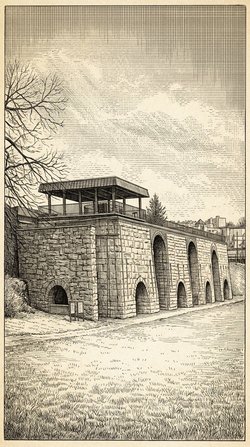
Construction began September 11, 1840. Simon Ward and William Manness oversaw the physical work. Workers quarried local stone and built the furnace stack along the brook, connecting it to a waterwheel-driven bellows system and hot-air ovens modeled on Henry’s Oxford Furnace design. The structure took about a year to complete.
The Failures
The furnace was ready by early autumn 1841. On October 9, the partners attempted the first hot blast. It failed.
The problems compounded. The furnace could not reach the temperatures needed to smelt iron from ore. Water levels in Roaring Brook dropped too low to turn the waterwheel with enough force to drive the bellows. Different mixtures of anthracite, ore, and limestone produced nothing usable. The tuyeres, the openings that inject air into the furnace, clogged repeatedly.
The partners tried everything they could think of. They burned wood and charcoal alongside the anthracite to raise temperatures. They added salt and brimstone to intensify the heat. A second attempt also failed. The investors had sunk their capital into a furnace that would not function, and the company faced collapse.
John F. Davis
George Scranton recruited John F. Davis, a Welsh ironworker with practical experience running anthracite furnaces. Davis understood what the New Jersey investors did not: the problem was not the fuel but the machinery. The hot-air ovens were too small. The bellows did not deliver enough volume or pressure.
Under Davis’s direction, workers enlarged and multiplied the hot-air ovens. They altered the machinery to increase air flow. They adjusted the charge mixtures, the precise ratios of coal, ore, and limestone fed into the top of the furnace.
On January 18, 1842, the furnace was successfully blown in. It produced roughly two and a quarter tons of pig iron per day. Over the next five weeks, before shutting down for repairs, the furnace yielded 75 tons of iron. The experiment had worked.
What Anthracite Changed
The Scranton furnace was not the first in America to use anthracite. David Thomas, another Welsh ironmaster, had achieved the first commercially successful anthracite iron production at Lehigh Crane Iron Works on July 4, 1840, more than a year before the Scranton furnace even attempted its first blast. Several furnaces in the Lehigh Valley were already operating.
But the Scranton furnace proved something different. It demonstrated that anthracite iron production could work in the Lackawanna Valley, where coal deposits were enormous and largely untapped. Anthracite burned hotter and more consistently than charcoal, and the supply was practically inexhaustible. One estimate from the 1850s calculated that anthracite cut production costs by 25 percent while producing superior iron.
After the First Iron
The 75 tons of pig iron from those first five weeks were modest. But they were enough. The partners kept the furnace running, and by 1844 it was producing five to seven tons of pig iron daily.
In 1846, George Scranton secured a contract with the New York and Erie Railroad to supply 12,000 tons of T-rails. No American company had manufactured rails at that scale. The furnace that nearly bankrupted its owners became the foundation of an industrial operation that, by 1865, had the largest iron production capacity in the United States.
The five-house hamlet of Slocum Hollow was renamed Scranton in 1851. By then, the furnaces employed more than 800 workers.
Timeline of Events
William Henry achieves first successful hot blast at Oxford Furnace, New Jersey
Henry scouts the Lackawanna Valley for anthracite iron production
Henry and partners purchase 503 acres in Slocum Hollow for $8,000
Workers break ground on first blast furnace along Roaring Brook
First hot blast attempted; tuyeres clog, furnace fails to reach smelting temperature
Second attempt lasts four days before failing
Third attempt fails; partners experiment with wood, charcoal, salt, and brimstone
Furnace successfully blown in under direction of John F. Davis; produces 2.25 tons per day
Furnace shuts down for repairs after producing 75 tons of pig iron
Sources & Further Reading
- Scranton Iron Furnaces , Wikipedia (2025)
- George W. Scranton , Wikipedia (2025)
- Lackawanna Iron and Coal Company Furnaces , Society of Architectural Historians (2017)
- The Scranton Story , Foundation for Economic Education (1998)
- Scranton Iron Furnaces , Pennsylvania Historical and Museum Commission (2024)
- Iron Furnaces , Pennsylvania Anthracite Heritage Museum (2024)