The Event
The Von Storch Colliery
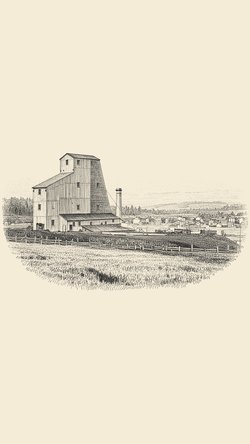
Ferdinand von Storch founded the Von Storch Coal Company, which began mining on Green Ridge in 1857. The von Storch family had introduced the burning of coal for heat in Philadelphia and New York harbor. By the 1860s, the Delaware and Hudson Canal Company had taken over the operation. Thomas H. Johnson photographed the breaker around 1863 to 1865, documenting the colliery in its early decades under D&H control.
The mine sat on Nay Aug Avenue off Green Ridge Street, on the northeastern side of Scranton. Workers reached the coal through the River Slope, which accessed veins at relatively shallow depths. The deck vein lay about 100 feet below the surface. The surface vein sat roughly 60 feet down.
October 30, 1897
On Saturday, October 30, fire broke out in the River Slope of the Von Storch mine. Flames consumed the slope itself, the primary way in and out of the workings. Smoke poured into the passages where men were still underground.
The miners had two possible escape routes. The first was the slope, now a wall of fire. The second was a longer path through cross-cuts to gangways leading to an air shaft nearly a mile from the slope entrance. But the smoke backed into every passage. The ventilation system that normally cleared the workings instead carried poisonous air through the cross-cuts and gangways, cutting off the second route.
Six men died of suffocation. Thomas Hill, the mine boss, was among them. So were John Farrell, a company man; John Francis Moran, a driver; Michael Walsh, a laborer; John McDonnell, a miner; and Thomas Padden. A seventh man, identified in press accounts only as “a Polander,” was initially counted among the dead.
Yomaski’s Ten Hours
Joseph Yomaski survived. Trapped underground with smoke filling every passage, he found an old abandoned airway. He took a hand fan, placed a box over the airway opening, and inserted his head into the space between the box and the opening. Then he worked the fan continuously, pulling small amounts of breathable air through the old passage.
He kept this up for ten hours. Rescue teams pulled him out at 10:00 PM Saturday night.
The Firemen Underground
Chief Hickey of the Scranton Fire Department led eight firemen into the mine to fight the blaze and search for survivors. While they worked underground, the air current shifted direction. The same ventilation reversal that had trapped the miners now turned on the rescuers. All nine men nearly died before they managed to reach the surface.
The fire was the deadliest incident in the Lackawanna and Wyoming coal fields since the Twin Shaft disaster at Pittston, which had occurred just over a year earlier. Newspapers across the country carried the story. The Logansport Pharos-Tribune in Indiana ran the account on November 1 under the headline “Suffocated in a Coal Mine.”
A Dangerous Place to Work
The 1897 fire was not the first time Von Storch killed its workers, and it would not be the last time the mine burned. Accident records from the 1870s list a steady count of fatalities. John Moran, age 40, married with seven children, died on March 16, 1875. John Narry, 40, married with five children, died on April 19, 1875. John John, 24, married with one child, died May 15, 1875. Non-fatal injuries struck workers as young as thirteen.
In March 1897, seven months before the fire, Charles Thomas died at the Von Storch shaft. He was 58, a company man, and left behind six orphans. Harry von Storch, a teenager from the founding family, lost an arm in an accident at the colliery.
The 1937 Fire
Forty years after the first disaster, Von Storch burned again. On October 25, 1937, workers discovered fire in the Big Vein, 250 feet underground. The mine was then operated by Penn Anthracite Colliers Company. A rock fall had broken electric trolley wires, and the sparks ignited timber supports and a wooden flush pipe.
The 14-foot Big Vein had been idle for months. The fire started at about 90 feet across and spread to 400 feet. Fissures between the coal veins made sealing the fire impossible through conventional methods. The blaze threatened three neighboring operations: the Dickson mine (Hudson Coal Company), the Cayuga mine (Glen Alden Coal Company), and the Diamond mine (Monarch Anthracite Mining Company).
Mayor Stanley Davis pledged city cooperation. Mine Inspector L.M. Evans took charge of the firefighting effort. The fire burned for nearly four months before it was declared extinguished on February 17, 1938.
After the Coal
Penn Anthracite built a new Von Storch Breaker in 1926 and 1927. It served as the main preparation plant for the company, processing coal from eleven separate mining operations. The breaker shut down in 1948 and was dismantled.
The culm banks that had accumulated over nearly a century of mining were reclaimed through the 1960s and 1970s. The Green Ridge Shopping Plaza was built on the former colliery site. One section of the breaker survived into the early 2000s, repurposed as coal storage pockets, before it too was torn down.
Timeline of Events
1857
Von Storch Coal Company begins mining operations at the colliery
1863
Thomas H. Johnson photographs the Von Storch Breaker under Delaware and Hudson Canal Company operation
1897-10-30
Fire breaks out in the River Slope; six miners and workers die of suffocation
1937-10-25
Second fire discovered in the Big Vein, 250 feet underground, under Penn Anthracite Colliers Co.
1926
New Von Storch Breaker constructed on Nay Aug Avenue off Green Ridge Street
1938-02-17
1937 fire declared extinguished after four months of firefighting
1948
Breaker shut down and dismantled
1960
Culm banks reclaimed through the 1960s and 1970s
Sources & Further Reading
- Suffocated in a Coal Mine , Logansport Pharos-Tribune (1897)
- Von Storch Mine Fire , US Mine Disasters (2024)
- Von Storch Colliery , Underground Miners (2024)
- Local History: Mine fire scorched Von Storch , Scranton Times-Tribune (2012)
- Lackawanna County Mine Accidents 1875-1877 , Lackawanna PAGenWeb (2024)
- Lackawanna County Mine Accidents 1897 , Lackawanna PAGenWeb (2024)
- Lake Underwood History , Lake Underwood Nimrod Club (2024)
- Von Storch Breaker, Delaware and Hudson Canal Co. , Albany Institute of History & Art (2024)