Baptist Worship Before the Church
Baptist worship in the Lackawanna Valley predates the city of Scranton by more than sixty years. In 1794, Rev. William Bishop arrived in the Hyde Park area and began holding services in his log cabin. His was the first Baptist congregation in what would become Lackawanna County.
That early effort ended abruptly in 1803 when fire destroyed Bishop’s cabin. He left for New Jersey and Baptist worship in the valley ceased entirely. Nearly half a century passed before Baptists organized again. On September 12, 1849, the Hyde Park Baptist Church formed under Rev. William K. Mott, serving the neighborhood west of Roaring Brook.
Founding on Franklin Avenue
On August 22, 1859, twenty-five people gathered at the home of Nathaniel Hallstead on Franklin Avenue and organized the First Baptist Church of Scranton. The new church was distinct from the Hyde Park congregation. It served the growing central city, which had incorporated just three years earlier.
Rev. Isaac Bevan accepted the call as first pastor on November 1, 1859. He started with a membership of 23. Bevan would serve the congregation for a full decade, building it from a handful of worshippers meeting in a private home into an established church with its own building.
The Penn Avenue Building
Between 1865 and 1867, the congregation built its first church at 230 Penn Avenue. The building cost $20,000 and seated 450. On January 4, 1866, the church incorporated under the name “The Baptist Church of Scranton.”
Rev. Bevan resigned on November 2, 1869, having grown the membership from 23 to 201. Rev. W. P. Hellings succeeded him on February 1, 1870, and proved equally effective. During Hellings’ tenure, 388 new members joined.
On September 1, 1880, Rev. David Spencer became pastor. Spencer had previously served as secretary of the American Baptist Missionary Union. He is also credited with coining Scranton’s “Electric City” nickname after the city’s early adoption of electric streetcars. On June 27, 1881, the church was renamed the Penn Avenue Baptist Church of Scranton.
Growth and Membership
By 1884, twenty-five years after its founding, 1,124 persons had been connected with the church. Total funds raised over that period amounted to $150,045.78. From a prayer meeting in a private home, the congregation had become one of the larger Protestant churches in northeastern Pennsylvania.
The church’s Sunday School drew members beyond the regular congregation. Lemuel Amerman, a Scranton attorney who later served as a U.S. Congressman from 1891 to 1893, was superintendent of the Sunday School for seven years.
The Move to Jefferson Avenue
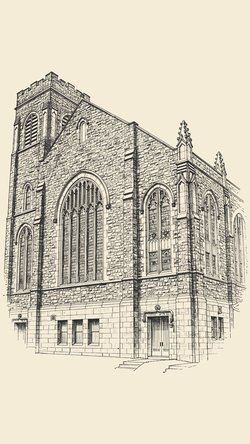
By the early 1900s, Penn Avenue was becoming increasingly commercial. The congregation decided to relocate to a residential area better suited to a church. In April 1909, construction began on a new building at the corner of Mulberry Street and Jefferson Avenue.
Services commenced in the new building on January 4, 1910, and the church took the name Immanuel Baptist Church. The formal dedication followed on December 11, 1910. Construction cost $135,000, nearly seven times the cost of the original Penn Avenue building.
The Organ
The new building’s most notable feature was its pipe organ. Designed by J. Alfred Pennington, who also served as the church’s first organist, the instrument contained 3,500 pipes and cost $20,000. At the time of its installation in 1910, it was the second-largest organ in Pennsylvania.
Merger and Afterlife
On October 13, 1984, three Baptist congregations merged. Immanuel Baptist, Bethany Baptist of South Scranton, and Green Ridge Baptist combined to form Trinity Baptist Church. The new church relocated to 1546 Monsey Avenue, where it continues as a member of the American Baptist Churches USA.
The Immanuel Baptist building at 346 Jefferson Avenue sat empty until 1986, when the University of Scranton purchased it. In 1988, the university rededicated the space as the Houlihan-McLean Center for Performance Music, a 650-seat concert hall. The building where Baptists worshipped for seventy-four years now hosts recitals and orchestral performances.
Company Timeline
1794
Rev. William Bishop arrives in Hyde Park area; establishes first Baptist worship in Lackawanna County from his log cabin
1803
Fire destroys Bishop's log cabin; he leaves for New Jersey and Baptist presence in the valley lapses
1849-09-12
Hyde Park Baptist Church organized with Rev. William K. Mott as pastor
1859-08-22
Twenty-five members organize the First Baptist Church of Scranton at Nathaniel Hallstead's home on Franklin Avenue
1859-11-01
Rev. Isaac Bevan becomes first pastor; starting membership stands at 23
1866-01-04
Incorporated under the name 'The Baptist Church of Scranton'
1867
Church building completed at 230 Penn Avenue; cost $20,000 with seating for 450
1869-11-02
Rev. Bevan resigns after ten years; membership has grown from 23 to 201
1870-02-01
Rev. W. P. Hellings becomes pastor; adds 388 members during his tenure
1880-09-01
Rev. David Spencer, former secretary of the American Baptist Missionary Union, becomes pastor
1881-06-27
Church renamed Penn Avenue Baptist Church of Scranton
1909-04
Construction begins on new building at Mulberry Street and Jefferson Avenue
1910-01-04
Services begin in new building; church renamed Immanuel Baptist Church
1910-12-11
New building formally dedicated; construction cost $135,000
1910
Pipe organ with 3,500 pipes installed at a cost of $20,000; second-largest organ in Pennsylvania at the time
1984-10-13
Immanuel Baptist merges with Bethany Baptist and Green Ridge Baptist to form Trinity Baptist Church
1986
University of Scranton purchases former Immanuel Baptist building at 346 Jefferson Avenue
1988
Building rededicated as Houlihan-McLean Center for Performance Music with 650 seats
Sources & Further Reading
- Local History: First Baptist Church in Scranton has long, storied history, Scranton Times-Tribune (2017)
- Local History: Immanuel Baptist has 100-year-plus history in Scranton, Scranton Times-Tribune (2019)
- Baptist Churches of Lackawanna County, LackawannaPAGenWeb (2024)
- Baptist Churches in Lackawanna County, LackawannaPAGenWeb (2024)
- Houlihan-McLean Center, University of Scranton (2024)
- Lemuel Amerman, Wikipedia (2024)