Origins in New Jersey
The Central Railroad of New Jersey began as the Elizabethtown and Somerville Railroad, incorporated in 1831 to connect two small New Jersey towns. Horse-drawn cars started running from Elizabethport to Elizabeth in 1836. Steam locomotives replaced the horses three years later. By 1842, the line reached Somerville.
On February 11, 1849, the Elizabethtown and Somerville merged with the Somerville and Easton Railroad to form the Central Railroad Company of New Jersey. John Taylor Johnston, 28 years old, became the first president. He held the position for nearly three decades and later founded the Metropolitan Museum of Art in New York.
Pushing West
The CNJ extended its main line west to Phillipsburg, New Jersey, on the east bank of the Delaware River, by 1852. From there it crossed into Easton, Pennsylvania. In 1864, the railroad pushed east across Newark Bay to a terminal at Communipaw in Jersey City, giving it direct access to New York Harbor.
The railroad’s location made it a natural connector between the coal fields of northeastern Pennsylvania and the markets of New York and New England. At peak operations, the CNJ system covered 711 miles of track.
The 999-Year Lease
On March 31, 1871, the CNJ leased the Lehigh and Susquehanna Railroad for a term of 999 years. The lease gave the CNJ a continuous rail corridor from Jersey City deep into the anthracite coal region of Pennsylvania. Two years later, the company acquired coal mines outright, consolidating them under a subsidiary called the Lehigh and Wilkes-Barre Coal Company.
The strategy was straightforward. Own the mines, own the railroad, control the product from extraction to delivery. The arrangement produced strong revenues through the end of the nineteenth century.
Scranton Becomes the Western Terminus
The CNJ purchased seven acres of land in Scranton from the Bridgewater Coal Company in 1880 to build terminal facilities. Eight years later, the Wilkes-Barre and Scranton Railroad, a subsidiary of the Lehigh and Susquehanna, completed a line from Pittston to Scranton. The distance from Jersey City to Scranton measured 192 miles.
Scranton sat at the far western end of the entire CNJ system. Every train that reached the city had crossed the full breadth of New Jersey and much of eastern Pennsylvania to get there. The railroad built freight and passenger terminals on its seven-acre parcel at 602 Lackawanna Avenue, with construction beginning around 1890. Wilson Brothers and Company of Philadelphia designed the buildings.
A roundhouse went up in the Bellevue section of the city to service the locomotives that worked the Scranton end of the line.
Fire at the Passenger Station
At 4:30 in the morning on December 18, 1910, fire broke out at the CNJ passenger station on Lackawanna Avenue. The blaze destroyed the building and two locomotives. Estimated losses reached $50,000. The fire eliminated the company’s passenger facilities in Scranton, though the freight station survived and continued operations for another six decades.
Coal and Camelbacks
The CNJ’s identity centered on anthracite. The railroad hauled coal from the mines of the Wyoming and Lehigh Valleys to piers in Jersey City, where twin McMyler car dumpers installed at Pier 18 in 1919 could empty rail cars directly into waiting barges and ships.
By the late 1920s, the CNJ operated 529 steam locomotives. More than 200 of these were camelback designs, a type with the cab mounted over the boiler rather than behind it. Camelbacks were common on anthracite railroads because the wide fireboxes needed to burn hard coal left no room for a conventional cab at the rear. The CNJ ran one of the largest fleets of camelbacks in the country.
The Mermaid
In 1922, the CNJ inaugurated “The Mermaid,” a named passenger train connecting Scranton to the Jersey Shore. The service carried vacationers from the coal towns of northeastern Pennsylvania to the beaches of the Atlantic coast. The Reading Company, which had purchased a controlling interest in CNJ stock in 1901, coordinated schedules across both railroads.
Three Bankruptcies
The anthracite market collapsed in the 1930s as oil and natural gas replaced coal for home heating. The 1920 Commodities Clause had already stripped railroads of the right to haul their own coal, eliminating the vertical integration that had made the CNJ profitable. Revenue fell steadily.
The CNJ entered receivership in 1939. It emerged from bankruptcy in 1944, only to file again in 1947. A brief period of stability followed, but the underlying economics never recovered. Passenger service at the Scranton station ended in the early 1950s. On March 22, 1967, the CNJ filed for bankruptcy a third time.
The End of Pennsylvania Operations
By the mid-1960s, the CNJ’s Pennsylvania operations had become unsustainable. The railroad and the Lehigh Valley Railroad consolidated their Pennsylvania lines in 1965 in an attempt to reduce costs. It was not enough.
On March 31, 1972, the CNJ ended all operations in Pennsylvania. The Scranton freight terminal on Lackawanna Avenue closed for good. The railroad continued running commuter trains in New Jersey for four more years before being absorbed into Conrail on April 1, 1976.
The Freight Station
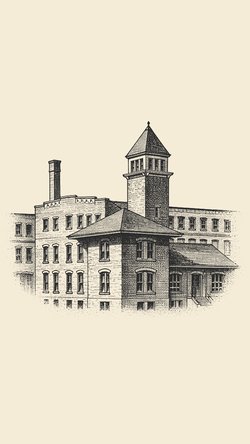
The CNJ freight station in Scranton outlasted the railroad itself. The brick building at 602 Lackawanna Avenue was added to the National Register of Historic Places in 1979, three years after the CNJ ceased to exist. It stands as one of the few physical reminders that the Jersey Central once ran trains 192 miles from tidewater to reach this city at the far edge of its map.
Scranton in the System
The CNJ was one of several railroads that competed for Scranton’s coal traffic in the late nineteenth and early twentieth centuries. The Delaware, Lackawanna and Western hauled anthracite north to Binghamton and east to Hoboken. The CNJ offered an alternative route southeast through the Lehigh Valley to Jersey City. For decades, the two railroads operated parallel to each other, serving the same mines and the same city from stations less than a mile apart on Lackawanna Avenue.
The competition ended the same way for both. The DL&W merged into the Erie Lackawanna in 1960 and reached Conrail by 1976. The CNJ arrived at the same destination by a different path. Two railroads that once fought over Scranton’s coal wound up as lines on the same Conrail system map.
Company Timeline
1831
Elizabethtown and Somerville Railroad incorporated in New Jersey
1839
First steam-powered train operates on the line
1849-02-11
Central Railroad Company of New Jersey formed by consolidation
1864
Line extended east to Jersey City terminal at Communipaw
1871-03-31
CNJ leases Lehigh & Susquehanna Railroad on a 999-year lease
1873
Lehigh & Wilkes-Barre Coal Company established as coal mining subsidiary
1880
CNJ acquires 7 acres in Scranton from Bridgewater Coal Company
1888
Wilkes-Barre & Scranton Railroad extends line to Scranton, making it the western terminus
1901
Reading Company purchases controlling interest in CNJ
1910-12-18
Fire destroys CNJ passenger station in Scranton at 4:30 AM
1939
CNJ enters receivership in first bankruptcy
1967-03-22
Third and final bankruptcy filing
1972-03-31
All CNJ operations in Pennsylvania cease
1976-04-01
CNJ absorbed into Conrail
1979
Scranton freight station added to National Register of Historic Places
Sources & Further Reading
- Central Railroad of New Jersey, Wikipedia (2025)
- Jersey Central Lines, American-Rails.com (2024)
- Scranton station (Central Railroad of New Jersey), Wikipedia (2025)
- The Central Railroad of New Jersey, Jersey Central Railroad Historical Society (2024)
- Central Railroad of New Jersey station a beacon of Scranton's better days, The Times-Tribune (2010)