The Scranton Brothers’ Railroad
George W. Scranton and his brother Selden needed a railroad. Their iron works at Slocum Hollow had secured a contract with the Erie Railroad to supply T-rails, but the finished product had to reach market. In 1832, they incorporated the Liggett’s Gap Railroad to connect their furnaces to the Erie at Great Bend, 40 miles north.
The first section opened in October 1851. To reach New York City, the brothers chartered the Delaware & Cobb’s Gap Railroad in 1850 to build south to the Delaware River. On March 11, 1853, the two lines consolidated into the Delaware, Lackawanna and Western Railroad.
The Anthracite Connection
The DL&W existed to move coal. Northeast Pennsylvania sat atop the largest anthracite deposits in the world, and New York City needed fuel. The railroad’s southern division, completed May 27, 1856, connected Scranton to the Delaware River at Slateford, where coal transferred to the Central Railroad of New Jersey for the final leg to tidewater.
By 1890, the DL&W shipped roughly 14 percent of all Pennsylvania anthracite. The company went further than most railroads, acquiring direct ownership of coal mines in 1851. This vertical integration let the DL&W profit as both transporter and producer. The arrangement lasted until 1921, when antitrust pressure forced the railroad to spin off its mining operations into the Glen Alden Coal Company.
The Sloan Years
Samuel Sloan took the presidency in 1867 and held it for 32 years. His tenure was conservative and extremely profitable. Coal moved steadily, the railroad paid dividends, and Sloan avoided the speculative expansion that bankrupted competitors. When he stepped down in 1899, the DL&W was one of the most financially stable railroads in the Northeast.
The Truesdale Modernization
William H. Truesdale succeeded Sloan with different ideas. He launched a modernization program that rebuilt much of the railroad’s infrastructure.
The Scranton yards, where locomotives were serviced and cars repaired, received particular attention. Between 1899 and 1926, Truesdale oversaw construction of a new roundhouse, machine shops, and support buildings. These facilities covered the blocks bounded by Lackawanna Avenue, Cedar Avenue, River Street, and Seventh Avenue.
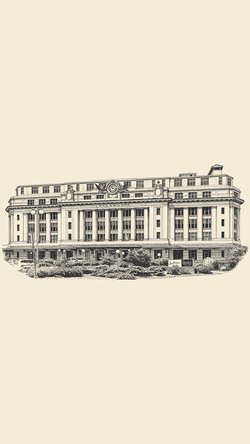
The new Scranton passenger station opened in 1908. Architect Kenneth Murchison designed a French Renaissance building faced in Indiana limestone, with an 8-foot bronze clock over the entrance and a waiting room finished in Formosa marble. The station cost approximately $600,000.
Truesdale also tackled the railroad’s grades. Between 1912 and 1915, crews built the Summit-Hallstead Cutoff between Clarks Summit and Hallstead, straightening and flattening the route between Scranton and Binghamton. The project included the Tunkhannock Viaduct, a reinforced concrete structure that remains the largest of its type in the world.
Expansion to Buffalo
The DL&W was not content with its Scranton-to-Hoboken corridor. In 1880, the company chartered the New York, Lackawanna & Western to extend the system from Binghamton to Buffalo. Construction took two years, and the 207-mile extension opened September 17, 1882.
At its peak, the DL&W operated nearly 1,000 miles of track from Buffalo to Hoboken. Scranton remained the operational headquarters.
Phoebe Snow
Around 1900, the DL&W created Phoebe Snow, a fictional woman dressed entirely in white who traveled the railroad without getting a speck of soot on her dress. The campaign advertised the cleanliness of anthracite coal compared to the soft coal burned by other railroads. Phoebe appeared in magazine advertisements, on billboards, and in promotional materials for decades.
In 1949, the DL&W revived the name for a new streamlined passenger train between Hoboken and Buffalo. The Phoebe Snow made its last run in 1966.
Merger and Dissolution
The anthracite industry that built the DL&W eventually killed it. Oil and natural gas replaced coal for home heating, and traffic declined steadily after World War II. The railroad’s passenger service lost money every year.
On October 17, 1960, the DL&W merged with the Erie Railroad to form the Erie Lackawanna Railway. The combined company struggled through the 1960s, went bankrupt after Hurricane Agnes flooded its main line in 1972, and was absorbed into Conrail on April 1, 1976.
What Remains
The 1908 Scranton passenger station closed in 1970 when the last trains stopped running. Listed on the National Register of Historic Places in 1977, it reopened in 1983 as the Radisson Lackawanna Station Hotel. The bronze clock still keeps time over the entrance, and the marble waiting room is now the hotel lobby.
The Scranton yards survived as Steamtown National Historic Site. The National Park Service operates the former DL&W facilities as a museum of steam railroading, preserving the roundhouse, maintenance buildings, and several historic locomotives.
The Pennsylvania Northeast Regional Railroad Authority now operates freight service over portions of the old DL&W main line between Scranton and the Delaware River.
Company Timeline
1832
Liggett's Gap Railroad incorporated
1850
Delaware & Cobb's Gap Railroad chartered
1853-03-11
DL&W formed by consolidating predecessor railroads
1851-10
First section opened from Scranton to Great Bend
1856-05-27
Southern Division completed to Delaware River
1867
Samuel Sloan becomes president
1882-09-17
Buffalo extension completed
1899
William H. Truesdale becomes president
1908
Scranton passenger station completed
1960-10-17
Merged with Erie Railroad to form Erie Lackawanna
Sources & Further Reading
- Delaware, Lackawanna and Western Railroad, Wikipedia (2025)
- Delaware, Lackawanna & Western Railroad Scranton Yards, Historic American Engineering Record (1994)
- Radisson Lackawanna Station Hotel, SAH Archipedia (2024)
- Delaware, Lackawanna & Western Railroad history remembered, Trains Magazine (2024)