Catholics Before the Diocese
Catholic worship in northeastern Pennsylvania began decades before any formal diocese existed. In 1787, Rev. James Pellentz made the first recorded priestly visit to the region. A few years later, between 1793 and 1794, French refugees fleeing the Revolution established Azilum in Bradford County, a settlement that included priests among its residents.
The first permanent Catholic church appeared in 1825, when parishioners built Saint Augustine at Silver Lake in Susquehanna County. Rev. John O’Flynn became its first resident pastor. Missionary work expanded through the 1830s under Rev. John Vincent O’Reilly, who arrived in 1838 and built St. Mary’s in Wilkes-Barre by 1842, along with opening St. Joseph’s College. Scranton itself did not have a Catholic church until 1852, by which time the surrounding region already had several established parishes.
Founding of the Diocese
On March 3, 1868, Pope Pius IX separated ten counties from the Archdiocese of Philadelphia and created the Diocese of Scranton. The new diocese encompassed roughly 8,500 square miles of northeastern Pennsylvania. It started with 50 churches and 25 priests serving a scattered Catholic population across Bradford, Lackawanna (added as the eleventh county in 1878), Luzerne, Lycoming, Monroe, Pike, Sullivan, Susquehanna, Tioga, Wayne, and Wyoming counties.
William O’Hara, born in Dungiven, County Derry, Ireland, and ordained in Rome in 1842, was consecrated as the first bishop on July 12, 1868. He inherited a diocese that was already growing fast. Anthracite coal mines and iron works drew immigrant laborers from Ireland, Poland, Italy, Lithuania, Germany, and the Austro-Hungarian Empire. Each wave of arrivals brought demand for new parishes, schools, and priests who could speak their language.
The Cathedral
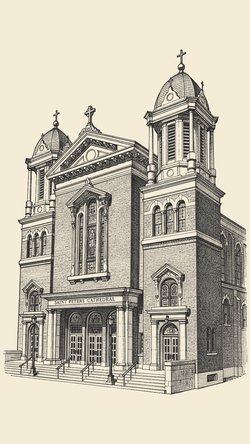
The building that would become the diocese’s cathedral started as St. Vincent de Paul parish church, constructed in 1867 at 315 Wyoming Avenue. Bishop O’Hara had it remodeled in the early 1880s and consecrated it as the Cathedral of Saint Peter on September 28, 1884. It was added to the National Register of Historic Places in 1976.
The Hodur Break
The ethnic tensions running through the diocese erupted most dramatically in the Polish community. On August 19, 1893, Bishop O’Hara ordained Franciszek Hodur, a Polish-born priest. Hodur grew frustrated with what he viewed as Irish-dominated church governance that marginalized Polish parishioners. On March 14, 1897, he organized an independent Saint Stanislaus parish in Scranton.
Bishop Hoban, serving as coadjutor, issued an excommunication letter against Hodur on September 29, 1898. Three days later, on October 2, Hodur burned the document. The break was final. Hodur went on to found the Polish National Catholic Church, which established its permanent headquarters in Scranton. The PNCC eventually grew into an international denomination, all tracing its origins to a dispute within the Diocese of Scranton.
O’Hara’s Three Decades
Bishop O’Hara served 31 years, the longest tenure of any Scranton bishop. When he died on February 3, 1899, the diocese had grown from 50 churches and 25 priests to 78 churches, 130 priests, 40 schools enrolling 12,000 students, and a Catholic population of 125,000. He had built the institutional infrastructure of northeastern Pennsylvania Catholicism almost from scratch.
The Immigration Era
Michael John Hoban succeeded O’Hara as the second bishop in 1899 and served until his death on November 13, 1926. His episcopate coincided with the peak of immigration to the anthracite region. An ethnic census taken in 1906 reveals the makeup of his flock: 133,000 English-speaking Catholics, 45,000 Polish, 21,000 Italian, 20,000 Greek Ruthenian, 16,000 German, 15,000 Slovak, and 13,000 Lithuanian.
Each ethnic group demanded parishes where services could be conducted in its own language and where national traditions could be preserved. By 1911, the diocese had swelled to 265,000 Catholics, 265 priests, 232 churches, and 49 schools. Hoban managed this enormous expansion for 27 years, navigating the competing demands of communities separated by language, culture, and old-country rivalries.
Mid-Century Peak
Two bishops followed Hoban in quick succession. Thomas O’Reilly served as third bishop from 1927 to 1938, and William Hafey as fourth from 1938 to 1954. The diocese continued growing through the Depression and World War II, reaching 350,876 Catholics with 231 parishes and 540 priests by 1950. Jerome Hannan, the fifth bishop, served from 1954 to 1965, and Joseph McCormick, the sixth, from 1966 to 1983.
The diocese peaked in the early 1980s at roughly 359,513 Catholics, 240 parishes, and 544 priests. These numbers reflected the high-water mark of a region that had been losing population and economic vitality since the anthracite industry collapsed in the 1950s. The gap between the number of parishes built during the immigration boom and the shrinking population that remained to fill them would define the diocese’s challenges for the next four decades.
John O’Connor’s Brief Tenure
On May 6, 1983, John O’Connor was appointed the seventh bishop of Scranton. His time in the diocese lasted barely eight months. On January 26, 1984, the Vatican transferred him to become Archbishop of New York. He was elevated to cardinal on May 25, 1985. O’Connor’s appointment to Scranton proved to be little more than a waystation on his path to one of American Catholicism’s most prominent positions.
The Timlin Years
James Timlin was appointed eighth bishop on April 24, 1984, beginning an episcopate that would span nearly two decades. Timlin presided over a diocese entering a long period of demographic decline. Parishes that had served distinct ethnic neighborhoods increasingly found themselves with aging congregations and dwindling attendance. The economic contraction that followed the loss of anthracite, railroads, and manufacturing continued to push younger residents out of the region.
Timlin retired in 2003. His legacy would be defined not by the administrative challenges he faced but by the abuse scandal that engulfed the diocese years later. The 2018 Pennsylvania grand jury report documented that Timlin had mishandled cases involving predator priests. Bishop Bambera permanently barred Timlin from representing the diocese at public events in 2018. Timlin died on April 9, 2023, at the age of 95.
Martino and the Closings
Joseph Martino became the ninth bishop in 2003 and immediately confronted the arithmetic of decline. The diocese had nearly 200 parishes but not enough parishioners or priests to sustain them. Beginning in 2007, Martino launched a restructuring that reduced the number of parishes from 196 to approximately 120. Schools closed alongside them. The consolidations generated fierce opposition from parishioners who had grown up in their neighborhood churches and could not accept watching them go dark.
On August 31, 2009, Martino resigned at age 63, citing “insomnia and crippling physical fatigue.” He was one of the youngest bishops in recent memory to step down. The abruptness of his departure, after barely six years in office and in the middle of the restructuring he had initiated, left the diocese without settled leadership at a difficult moment.
The Grand Jury Report
On August 14, 2018, a Pennsylvania grand jury released the results of a two-year investigation into sexual abuse in six Catholic dioceses. The report named 59 priests from the Diocese of Scranton among 301 statewide identified as “predator priests.” The findings documented decades of abuse and institutional cover-up.
Bishop Joseph C. Bambera, who had been installed as tenth bishop on April 26, 2010, cooperated with the investigation and released diocesan files to prosecutors. Born March 21, 1956, in Carbondale, Pennsylvania, Bambera was a native of the diocese he led. He publicly acknowledged the failures of his predecessors and barred former Bishop Timlin from representing the diocese at public events.
Vision 2030
In January 2022, Bambera launched “Vision 2030,” a planning initiative to address continuing demographic and financial pressures. The diocese, which had 240 parishes in 1980, was down to 106. Catholic population had fallen from its peak of roughly 360,000 to approximately 317,429, about 29 percent of the total population across the eleven-county territory.
The diocese currently employs 255 priests (214 diocesan and 41 religious) and 93 deacons. It operates 19 schools, four high schools and 15 elementary schools, enrolling approximately 14,500 students. The chancery is located at 300 Wyoming Avenue, one block from the Cathedral of Saint Peter at 315 Wyoming Avenue.
Company Timeline
1787
Rev. James Pellentz makes the first recorded priestly visit to the region
1825
First Catholic church (Saint Augustine) built at Silver Lake, Susquehanna County; Rev. John O'Flynn becomes first resident pastor
1842
First Catholic church in Wilkes-Barre (St. Mary's) built; Father O'Reilly opens St. Joseph's College
1852
First Catholic church in Scranton built
1867
St. Vincent de Paul parish church (future Cathedral of Saint Peter) built at 315 Wyoming Avenue
1868-03-03
Pope Pius IX erects the Diocese of Scranton from territory of the Archdiocese of Philadelphia; 10 counties, 50 churches, 25 priests
1868-07-12
William O'Hara consecrated as first bishop
1878
Lackawanna County created, becoming the diocese's 11th county
1884-09-28
Cathedral remodeled and consecrated as Cathedral of Saint Peter
1893-08-19
Franciszek Hodur ordained by Bishop O'Hara
1897-03-14
Hodur organizes Saint Stanislaus parish in Scranton
1898-10-02
Hodur burns his excommunication document; formal break leads to founding of the Polish National Catholic Church
1899-02-03
Bishop O'Hara dies; diocese has grown to 125,000 Catholics, 78 churches, 130 priests, 40 schools
1899
Michael John Hoban becomes second bishop
1926-11-13
Bishop Hoban dies after 27 years; diocese has 265,000 Catholics, 265 priests, 232 churches
1984-01-26
John O'Connor transferred to become Archbishop of New York after approximately eight months as seventh bishop
2007
Bishop Joseph Martino launches restructuring, reducing parishes from 196 to approximately 120
2009-08-31
Bishop Martino resigns at age 63, citing insomnia and physical fatigue
2010-04-26
Joseph C. Bambera installed as tenth bishop
2018-08-14
Pennsylvania grand jury report names 59 predator priests from the Diocese of Scranton
2022-01
Bishop Bambera launches Vision 2030 for further parish consolidations
Sources & Further Reading
- Diocese of Scranton Historical Overview, Diocese of Scranton (2024)
- About the Diocese of Scranton, Diocese of Scranton (2024)
- About the Bishop, Diocese of Scranton (2024)
- Scranton (Diocese), Catholic-Hierarchy.org (2024)
- Scranton, Catholic Encyclopedia (New Advent) (1911)
- St. Peter's Cathedral, Clio (2024)
- Bishop Francis Hodur, Central Diocese PNCC (2024)
- Bishop Bambera Announces Decision on Status of Bishop Emeritus James C. Timlin, Diocese of Scranton (2018)
- Michael John Hoban, Wikipedia (2024)
- Bishop John Joseph O'Connor, Catholic-Hierarchy.org (2024)
- Joseph Martino, Wikipedia (2024)
- Grand jury investigation of Catholic Church sexual abuse in Pennsylvania, Wikipedia (2024)
- Bishop James C. Timlin Dies at 95, Diocese of Scranton (2023)
- Vision 2030 Confronts Changing Realities, Diocese of Scranton (2022)