A Revolutionary in Scranton
Jacob Robinson was born Peter Jacob Robinson on March 26, 1825, in Lauterecken, a small town in the Bavarian Palatinate. In 1848, he joined the German Revolution against the monarchies of the German Confederation. The uprising failed. Robinson was arrested, convicted of treason, and imprisoned for eighteen months.
After his release, Robinson emigrated to America, arriving in June 1851 and settling in Scranton, where the coal and iron boom was drawing thousands of immigrants from across Europe. His wife, Elizabeth Margaretha Heintz Robinson, born in 1819, followed with their children the next year. By 1854, Jacob’s parents and three brothers, Christian, Charles, and Phillip, had also made the crossing.
Robinson threw himself into the civic life of his adopted city. Between 1856 and 1860, he organized and captained a German militia company called the Scranton Yeagers. In 1862, the same year he won election to the Pennsylvania Legislature, he founded a brewery on Cedar Street in Scranton.
The Linden Street Brewery
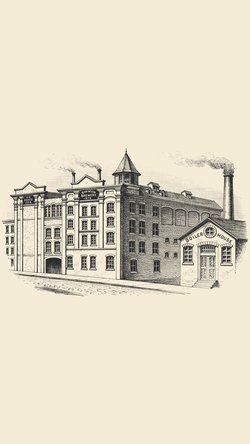
Robinson operated on Cedar Street for more than a decade before moving the brewery to a larger site at Linden Street and North Seventh Street (now North 7th Avenue) in 1875 or 1876. The new complex would later be described by brewery historians as Scranton’s best example of brewery architecture.
Jacob Robinson did not live long enough to see the full growth of his enterprise. He died on July 23, 1877, at the age of 52. His widow Elizabeth, then in her late fifties, took charge of the business. Their sons Charles, August, Lewis, and William assisted her, but she ran the brewery for thirteen years before turning it over to them.
In 1890, the sons formally took control and adopted the trade name E. Robinson’s Sons Brewery. The “E.” stood for Elizabeth. The brewery produced lager, ale, and porter under labels including Export Beer, Robinson’s Sons Beer, E. Robinson’s Sons Pilsener, Sparkling Ale, and Porter.
The Pennsylvania Central Brewing Company
On October 1, 1897, Charles Robinson joined with Patrick and Andrew Casey of Casey & Kelly Brewing to form the Pennsylvania Central Brewing Company. The new corporation assumed management of approximately twelve breweries across northeastern Pennsylvania, and the Robinson plant became the “E. Robinson’s Sons Dept.” of PCBC. Charles Robinson served as president of the combined company while continuing to manage the Robinson branch directly.
Three weeks later, on October 25, 1897, the PCBC executed a $2,800,000 mortgage bond through the Fidelity Insurance Trust & Safe Deposit Company of Philadelphia to finance the consolidation. The Robinson plant served as PCBC’s main branch, and by 1910 the company’s aggregate capacity reached roughly 450,000 barrels per year. Casey & Kelly’s Ale was brewed at the Robinson plant alongside the Robinson labels.
PCBC consolidated aggressively during this period, closing several of its branch breweries. The Mina Robinson brewery in Scranton and the Hartung brewery in Honesdale both shut down in 1910.
August Robinson and the Family’s Reach
August Robinson, born in 1848, managed the brewery alongside his brother Charles and became one of Scranton’s more connected businessmen. He served as a director of the Scranton Trust Company and County Savings Bank, presided over the Liederkranz music society, and held membership in the Scranton Elks lodge. He lived at 629 Clay Avenue.
August died on July 10, 1911, at the age of 63. His death removed one of the last Robinson brothers active in Scranton’s business community.
In 1904, Otto J. Robinson, another family member who served on the PCBC board, co-founded the Standard Brewing Company at Penn Avenue and Walnut Street with Patrick Cusick. Standard operated independently of PCBC.
Prohibition and Collapse
Prohibition in 1920 shut down every PCBC operation. The company’s twelve-brewery empire, financed by nearly three million dollars in bonded debt, had no product to sell. For over a decade, the plants sat idle.
On April 1, 1932, PCBC defaulted on its bond interest and sinking fund obligations. By May 18 of that year, the board of directors authorized transferring the company’s stock to the mortgage trustee.
When Prohibition was repealed in December 1933, the Robinson plant was the only PCBC branch to reopen. The company invested over $100,000 in new equipment and renovations to bring it back into production. But the effort to reorganize under Section 77B of the Bankruptcy Act failed because the company could not secure the required two-thirds consent of its bondholders. On March 8, 1937, a federal court ordered PCBC liquidated.
Auction and Demolition
PCBC’s properties went to auction in 1938. Ted Smulowitz, the sales manager of Lion Brewery in Wilkes-Barre, purchased the E. Robinson’s Sons plant for $31,000. The price was a fraction of what the Robinson family had built over seventy-five years.
The brewery complex stood for another half century. Around 1991, the PA Brewery Historians conducted a tour of the building, which still retained much of its original structure. Shortly after that visit, the building was condemned and demolished. The demolition proved more difficult than anticipated. The walls and foundations, built to support the weight of industrial brewing equipment, resisted the wrecking crews with the same stubbornness that had kept them standing for over a century.
Nothing remains of the brewery at Linden Street and North Seventh Street. The site where Jacob Robinson, a failed Bavarian revolutionary turned Scranton brewer, built his business in 1875 is empty ground.
Company Timeline
1825-03-26
Founder Jacob Robinson born in Lauterecken, Bavaria
1848
Jacob participates in German Revolution; arrested and imprisoned 18 months for treason
1851-06
Jacob arrives in America, settles in Scranton
1862
Jacob founds brewery on Cedar Street, Scranton
1875
Brewery relocates to Linden Street and North Seventh Street (now North 7th Avenue)
1877-07-23
Jacob Robinson dies at age 52; widow Elizabeth takes over operations
1890
Trade name becomes E. Robinson's Sons Brewery as sons assume full control
1897-10-01
Pennsylvania Central Brewing Company formed; Robinson brewery becomes a department of PCBC
1920
Prohibition shuts down PCBC operations
1933-12
Robinson plant reopens as only PCBC branch to resume after Prohibition repeal
1937-03-08
Federal court orders PCBC liquidation
1938
Ted Smulowitz acquires Robinson plant at auction for $31,000
1991
PA Brewery Historians tour the still-standing brewery complex
Sources & Further Reading
- E. Robinson's Sons Brewery, Rich Wagner, PA Brewery Historians (2024)
- The Pennsylvania Central Brewing Company, Rich Wagner, PA Brewery Historians (2024)
- Brewing in Honesdale, Pennsylvania, Rich Wagner, PA Brewery Historians (2024)
- E. Robinson's Sons Brewery of Scranton, Pennsylvania, USA, Tavern Trove (2024)
- Peter Jacob Robinson (1825-1877), WikiTree (2024)
- August Robinson (1848-1911), Find A Grave (2024)
- In Re Pennsylvania Central Brewing Co., 18 F.Supp. 458 (W.D. Pa. 1937), vLex (2024)
- Local History: NEPA breweries, beer drinkers were more than ready to toast the end of Prohibition, Times-Tribune (2018)