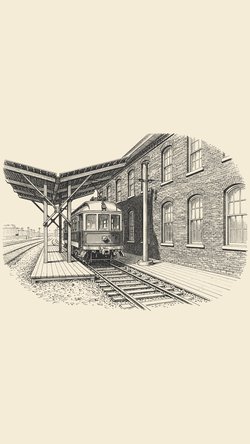
The Electric City
On November 30, 1886, Belgian-born electrical engineer Charles Van Depoele operated a test electric streetcar through the streets of Scranton. The city became the first in Pennsylvania to run a successful electric trolley, and the demonstration gave Scranton the nickname it still carries: The Electric City. Streetcar lines soon crisscrossed the city and its surrounding boroughs, while the Lackawanna & Wyoming Valley Railroad, known locally as the Laurel Line, ran electric interurban service between Scranton and Wilkes-Barre from 1903 to 1952, carrying as many as 4.2 million passengers a year at its peak.
By the mid-twentieth century, buses and automobiles had replaced every trolley line in the region. Scranton Transit Company ran its last streetcar on December 18, 1954. The tracks came up, the overhead wires came down, and within a generation only the nickname remained.
From Tansboro to Buckingham
The trolley cars that now run in Scranton arrived by way of a thirty-year odyssey through New Jersey and southeastern Pennsylvania. In the 1960s, a group of enthusiasts calling themselves the Metropolitan Philadelphia Railway Association began collecting trolleys and storing them in Tansboro, New Jersey. When that site proved untenable, the collection moved to Jobstown, New Jersey, in the early 1970s. Local residents objected. In 1973, Springfield Township passed an ordinance banning trolley storage and operation within its borders, and the group had to move again.
By 1978, the collectors had reorganized as the Buckingham Valley Trolley Association and relocated to Buckingham Township in Bucks County, Pennsylvania. There they operated trolley rides over a stretch of the New Hope & Ivyland Railroad, giving the public its first chance to ride the preserved cars.
Penn’s Landing
In 1982, the BVTA launched a more ambitious venture: a trolley line along Philadelphia’s waterfront. Running on the Belt Line Railroad from the Benjamin Franklin Bridge to Fitzwater Street, the Penn’s Landing Trolley charged one dollar for adults and fifty cents for children. Each car ran with a two-person crew, a motorman and a conductor.
The line found a steady audience. Ridership peaked during the 1987 bicentennial of the U.S. Constitution, and on July 4, 1992, a single day brought roughly 1,600 passengers. Volunteer operator Burt Eisenberg, who had been with the group since the Bucks County days, was among those running the cars through the bicentennial crowds.
But the Philadelphia waterfront was changing. Development pressure from the Penn’s Landing Corporation forced the trolley operation to shift its cars from pier to pier through the mid-1990s. Trolleys stored outdoors beneath Interstate 95 were vandalized, their copper wiring stripped. By 1996, the Penn’s Landing Corporation wanted Pier 9 for other uses. Charles Long, the former BVTA treasurer who had been a central figure in the Philadelphia operation, helped organize the move that followed. The fleet was loaded onto flatbeds and shipped north to Scranton.
A Museum in the Electric City
The Electric City Trolley Museum opened in 1999 on the grounds of Steamtown National Historic Site, a fitting home for a collection that had spent decades looking for one. The museum leased its facility from the National Park Service while Lackawanna Heritage Valley Authority oversaw its creation. Day-to-day operations fell to Lackawanna County, which provides two full-time mechanics. The all-volunteer Electric City Trolley Museum Association, a 501(c)(3) nonprofit, handles restoration work and fundraising.
The operating arrangement involves several parties. Trolleys run on tracks owned by Steamtown and the Pennsylvania Northeast Regional Railroad Authority, with Delaware-Lackawanna Railroad dispatching all movements. The excursion route extends roughly five miles one-way from the Steamtown complex through the 4,747-foot Crown Avenue Tunnel to a carbarn near PNC Field. As of 2019, the museum drew approximately 38,000 riders a year.
In 2006, a $2 million project funded by county and state money added a 2,000-foot extension connecting Steamtown to a new station and nine-car carbarn near PNC Field. The expansion gave the museum proper storage and a second boarding point.
The Collection
The museum holds more than 25 vehicles, though only a handful run regular excursion service. Philadelphia Suburban Transit Company car No. 76, a center-door Brill built in 1926, and No. 80, a lightweight Brill “Master Unit” from 1931, carry most of the excursion passengers.
Two cars with direct ties to Scranton anchor the restoration program. Scranton Railway Company No. 324, a J.G. Brill car from 1903, is one of only two northeastern Pennsylvania trolleys in the collection. Its restoration would return a Scranton-built car to Scranton tracks for the first time in decades. More ambitious is “Project 505,” the ongoing restoration of Scranton Transit No. 505, an Osgood Bradley “Electromobile” built in 1929. Car 505 is the sole survivor of the ten cars that made Scranton Transit’s final runs on December 18, 1954.
An Unexpected Donation
In September 2017, the museum received an unusual addition to its collection: a model train diorama from HBO’s “Last Week Tonight with John Oliver.” The show’s segment on infrastructure had featured the elaborate model, and producers donated it to the museum after taping. The diorama drew visitors who might not otherwise have sought out a trolley museum in northeastern Pennsylvania.
Visiting
The museum is located at 300 Cliff Street on the Steamtown grounds. Starting April 6, 2026, the museum opens daily from 9:00 a.m. to 4:00 p.m. Trolley excursions run Thursday through Sunday with departures at 10:30 a.m., noon, 1:30 p.m., and 3:00 p.m. during the spring-through-fall season. Museum-only admission is $9 for adults, $8 for seniors 62 and older, and $7 for children ages 3 to 17. Trolley ride tickets are $12, $11, and $10 respectively. A combination ticket covering both museum and ride costs $15 for adults, $14 for seniors, and $13 for children. Children two and under enter free.
Company Timeline
1886-11-30
Charles Van Depoele operates first electric streetcar in Scranton, earning the city its 'Electric City' nickname
1960s
Metropolitan Philadelphia Railway Association founded as trolley preservation group; first cars stored in Tansboro, New Jersey
1973
Springfield Township passes ordinance banning trolley storage, forcing the group to relocate
1978
Group renamed Buckingham Valley Trolley Association after moving to Bucks County, PA
1982
BVTA launches Penn's Landing Trolley in Philadelphia on Belt Line Railroad
1996
Penn's Landing line shut down; fleet relocated to Scranton
1999
Electric City Trolley Museum established on Steamtown grounds
2006
2,000-foot extension opens to new station and carbarn near PNC Field; $2 million project
2017-09
Museum receives John Oliver model train diorama from HBO's Last Week Tonight
Sources & Further Reading
- Electric City Trolley Museum, Wikipedia (2026)
- Electric City Trolley Museum Association, ECTMA (2026)
- Electric City Trolley Museum, Aaron Isaacs, Heritage Rail Alliance (2019)
- When trolleys trundled along the waterfront, Anthony Campisi, WHYY PlanPhilly (2009)
- Lackawanna and Wyoming Valley Railroad, Wikipedia (2026)