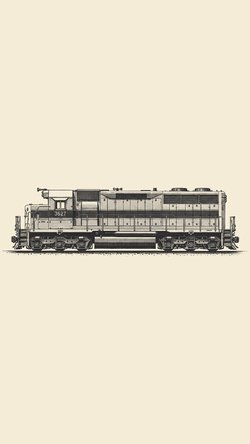
A Merger Born of Desperation
By the mid-1950s, both the Erie Railroad and the Delaware, Lackawanna and Western Railroad were bleeding money. The Lackawanna alone had lost nearly $1 million in 1955, its anthracite and cement traffic declining since the late 1940s while the Saint Lawrence Seaway, which opened in 1959, diverted ocean cargo to Great Lakes ports and starved Hoboken Terminal of revenue. Consolidation seemed like the only path forward, and the two railroads had already begun sharing resources before anything was official. Pre-merger, Erie trains started using Lackawanna’s Hoboken Terminal on October 13, 1956, and shared trackage between Binghamton and Gibson, New York, began in 1957. Erie’s Pavonia Terminal in Jersey City closed on December 12, 1958.
The ICC approved the merger on September 13, 1960, and the Erie Lackawanna Railroad came into existence on October 17 of that year. The combined system stretched 3,189 miles across New Jersey, Pennsylvania, New York, Ohio, Indiana, and Illinois, with headquarters at the Midland Building in Cleveland. Consulting firm Wyer, Dick and Company had projected $16.6 million in annual savings from the combination. The railroad adopted the motto “The Friendly Service Route,” and its logo, designed by Truman Knight, a former Erie fireman, combined Erie’s diamond with a stylized “E” forming an “L.” Knight’s entry won out over nearly 2,500 submissions and earned him twenty shares of common stock.
Leadership Struggles
The merger brought two corporate cultures together, and the collision was immediate. Harry Von Miller, an Erie man, became the first chairman, president, and chief operating officer. Perry Shoemaker, the former DL&W chief, was given the title of chairman but little decision-making authority. Frustrated, Shoemaker left in 1962 to join the Central Railroad of New Jersey.
Milton McInnes replaced Miller as president on November 22, 1960, but he struggled to manage the persistent personnel conflicts between former Erie and Lackawanna employees. The infighting consumed management energy that should have gone toward making the merger work. It was not until William “Bill” White arrived on June 18, 1963, that the railroad found capable leadership. White restructured the company’s crushing debt and streamlined operations. By 1963, annual savings from the merger had reached approximately $21 million, exceeding the original projections. White was considered one of the best railroad leaders of the century, which made his sudden death in 1967 a blow the company never fully absorbed.
The Penn Central Problem
The creation of Penn Central on February 1, 1968, upended the competitive dynamics of northeastern railroading. Almost overnight, Erie Lackawanna’s freight tonnage dropped by a third as shippers consolidated their business with the massive new system. By 1970, tonnage had been cut in half, costing EL an estimated $17 million annually. When the New Haven Railroad merged into Penn Central on January 1, 1969, it eliminated the interchange operations at Maybrook, New York, that EL had depended on.
Penn Central’s hostility went beyond ordinary competition. The larger railroad systematically sabotaged interchange traffic, holding EL freight cars for days or weeks instead of returning them. In 1969 alone, EL lost 34,000 cars worth $9.5 million in revenue. The losses continued at $8.3 million in 1970 and $4.8 million in 1971, though the number of cars affected declined to 22,900 and then 16,925 as EL reduced its interchange dependence. Meanwhile, the completion of Interstate 80 across Pennsylvania and New Jersey by 1971 diverted additional piggyback traffic from rail to truck.
Norfolk and Western Takes Control
On March 1, 1968, Erie Lackawanna became a subsidiary of Dereco, a holding company controlled by Norfolk and Western Railway. The railroad was simultaneously renamed from Erie Lackawanna Railroad to Erie Lackawanna Railway. Dereco also owned the Delaware and Hudson Railway. N&W’s investment was approximately $50 million, structured as a paper deal, and Jack Fishwick arrived under N&W sponsorship to oversee operations, with Gregory Maxwell serving as president beneath him.
The arrangement looked promising on paper but produced limited results. N&W ultimately benefited far more from the tax losses it could claim through Dereco, which exceeded $100 million and possibly reached $150 million, than from any operational improvements to the EL system.
Intermodal Innovation and Passenger Losses
Erie Lackawanna was an early pioneer in intermodal freight. Its predecessors had begun trailer-on-flatcar service as early as July 1954, and the merged railroad expanded the concept aggressively. In 1970, EL secured a contract with United Parcel Service and began operating five dedicated intermodal trains daily between New Jersey and Chicago. By 1973, intermodal volume hit a record 190,500 units, generating more than $46 million in revenue. The problem was speed. Penn Central offered 24.5-hour piggyback service between New York and Chicago in 1971, while EL’s trains took 28 hours and 45 minutes.
Passenger service, meanwhile, was being cut to the bone. The Pacific Express and Atlantic Express were discontinued in August 1965, followed by the Pocono Express and Twilight that fall. The Phoebe Snow, the Lackawanna’s signature long-distance train, made its final run on November 27-28, 1966. The Lake Cities followed on January 5-6, 1970, ending all long-distance passenger service. A late-1960s agreement with New Jersey provided subsidies for suburban commuter operations, which continued under separate arrangements.
Financial Spiral
The numbers told a grim story from the start. EL lost $26.4 million in 1961 and $16.6 million in 1962, with long-term debt exceeding $322 million by the end of that year. White’s reforms brought temporary stability, and by 1969 the railroad posted a modest net income of $1,259,000. That fragile recovery shattered the following year with a $10.89 million loss in 1970, followed by $2.247 million in 1971.
The first half of 1972 brought $16.292 million in losses, $5.4 million of that attributable to a single catastrophe. Total revenues in 1973 were $289,379,364, but expenses outpaced them. By 1974, the net loss had climbed to nearly $17.2 million.
Hurricane Agnes
In June 1972, Hurricane Agnes tore through northeastern Pennsylvania and New York’s Southern Tier, destroying 375 miles of EL trackage. The main line between Owego and Salamanca, New York, was particularly devastated. Crews worked continuously for 21 days to restore service, but the total damage and lost revenue reached $11 million. The storm was the final blow for a railroad already hemorrhaging cash.
On June 26, 1972, Erie Lackawanna filed for bankruptcy under Section 77 of the Federal Bankruptcy Act. Judge Robert Krupansky of the Northern District of Ohio oversaw the proceedings. Thomas Patton, retired chairman of Republic Steel, and Ralph Tyler Jr., retired chairman of Lubrizol Corporation, were appointed as trustees.
The Road to Conrail
Congress passed the Regional Rail Reorganization Act in 1973, creating a framework for salvaging the bankrupt railroads of the Northeast. EL initially opted out of the proposed Consolidated Rail Corporation in 1974, hoping to survive independently. A Santa Fe report from May 1975 suggested that six years of rehabilitation could generate $28 million in annual net after-tax income. The Chessie System agreed in 1975 to acquire EL’s lines east of Sterling, Ohio, for $155 million, but labor union negotiations prevented the deal from closing.
Financial reality forced EL to reverse course in January 1975. Federal assistance between March 1975 and April 1976 totaled approximately $50 million, but it only delayed the inevitable. Erie Lackawanna officially ceased operations on March 31, 1976. On April 1, approximately 1,200 miles of main line from northeastern Ohio to New Jersey were transferred to Conrail. By September 1977, Conrail had mothballed the western operations east of Marion, Ohio.
What Scranton Lost
The DL&W had been headquartered in Scranton since 1853, and its locomotive and car shops there, expanded in 1910 at a cost of $2 million, had been among the city’s largest employers. After the 1960 merger, the former DL&W shops and roundhouse remained operational through the early 1960s before being scaled back. The Hoboken to Scranton to Binghamton corridor was one of EL’s principal routes, and after 1974, nearly all EL freights were rerouted to the Scranton Division via the Lackawanna Cut-Off, the 28.45-mile shortcut completed in 1911 that EL had single-tracked in 1958. Conrail ceased operations on the Cut-Off in January 1979.
The Scranton yard site passed from EL to Conrail to the city itself. In 1983, Scranton agreed to relocate Steamtown, a railroad museum, from Vermont to the former yards, and in 1986 Congress approved $8 million to develop the site as Steamtown National Historic Site. The Delaware-Lackawanna Railroad currently operates the former Lackawanna mainline west of Portland, Pennsylvania, to Scranton.
Liquidation and Commemoration
EL Inc. was established on November 30, 1982, to handle the liquidation of remaining assets. The trustees negotiated a payment exceeding $350 million from the federal government for property transferred to Conrail, a dramatic improvement over the initial offer of approximately $60 million. Final liquidation was completed by 1992. Marion, Ohio, where EL had built a state-of-the-art diesel engine repair facility, saw its workforce decline from approximately 1,300 positions to far fewer.
Norfolk Southern repainted SD45-2 locomotive No. 1700 in EL colors in 2015, and NJ Transit wrapped ALP-45DP No. 4519 in the EL scheme in 2019. The commuter lines that once carried EL suburban passengers now operate under NJ Transit and Metro-North Railroad.
Company Timeline
1960-09-13
ICC approves merger of Erie Railroad and DL&W
1960-10-17
Erie Lackawanna Railroad officially formed
1963
Merger savings reach approximately $21 million annually
1963-06-18
William White joins as president and restructures debt
1966-11-28
Phoebe Snow passenger service discontinued
1967
William White dies suddenly
1968-03-01
Becomes subsidiary of Dereco under Norfolk and Western; renamed Erie Lackawanna Railway
1970-01-06
Long-distance passenger service ends entirely
1970
Secures United Parcel Service contract for five daily intermodal trains
1972-06
Hurricane Agnes destroys 375 miles of trackage
1972-06-26
Files for bankruptcy under Section 77
1976-04-01
Operations absorbed into Conrail
Sources & Further Reading
- Erie Lackawanna Railway, Wikipedia (2026)
- The Erie Lackawanna Railroad, American Rails (2025)
- Erie Lackawanna: The Unfortunate Merger, Ohio History Journal (1992)
- Erie Lackawanna Railroad, Encyclopedia of Cleveland History (2024)
- Erie Lackawanna Railway, Trains and Railroads (2025)
- Delaware, Lackawanna and Western Railroad, Wikipedia (2026)
- Lackawanna Cut-Off, Wikipedia (2026)
- Steamtown National Historic Site, Wikipedia (2026)