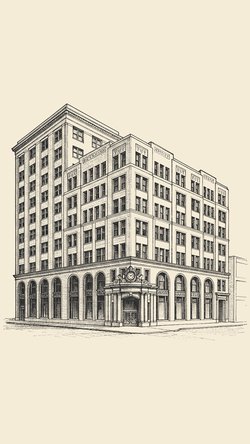
Chartering in 1863
The First National Bank of Scranton received Charter Number 77 on May 19, 1863, one of the earliest institutions organized under the National Banking Act passed earlier that year. Its organization date was May 30, 1863, and its operational charter took effect on September 7. The Articles of Association set initial capital stock at $200,000, divided into 2,000 shares of $100 each, with a provision permitting capital to grow to as much as $1,000,000.
Joseph H. Scranton served as the first President while simultaneously leading the Lackawanna Iron and Coal Company, linking the new bank directly to the city’s largest industrial employer. William Gushing, appointed Cashier in July 1863 at a salary of $1,500 per year, handled daily operations. The founding directors included Thomas Dickson, then general manager of the Delaware and Hudson Canal Company, along with John Brisbin, Joseph J. Albright (who served as Vice-President during the 1860s), and Joseph C. Platt. In June 1865, James A. Linen stepped in as Acting Cashier and was formally appointed to the post on October 3 of that year.
The Lackawanna and Wyoming Corner
The bank opened in temporary quarters at 430 Lackawanna Avenue and, in October 1863, moved to a banking room at the southwest corner of Lackawanna and Wyoming Avenues. That intersection anchored the institution for the next forty years. On November 15, 1866, the directors purchased the lot and building from John Koch for $14,750, giving the bank ownership of the corner outright.
The 1903 Banking House
On February 9, 1901, the Board authorized construction of a new banking house on the same corner. While the new building went up, the bank operated from temporary quarters at 422 Lackawanna Avenue starting November 27, 1901. Staff returned to the finished building on June 22, 1903, and the total cost of the structure and furnishings came to $193,802.51.
By 1906, the bank’s own corporate history reported that it had “reached, on the Roll of Honor of the national banks of the United States, a place second only to the Chemical National Bank of New York City.” That year’s officers were James A. Linen as President, George L. Dickson as Vice-President, Isaac Post as Cashier, and F. I. Linen as Assistant Cashier. The board also included W. W. Scranton, F. E. Platt, and C. L. Dickson.
Currency and the Charter 77 Era
As a national bank, the First National issued its own paper currency backed by government bonds, and its notes were pen-signed by the president and cashier before entering circulation. Over the institution’s full run it issued eleven different types and denominations of national currency, totaling $29,103,960 across 2,375,302 notes.
The charter itself changed numbers twice. The original Charter 77 liquidated on May 18, 1882, and the bank continued under successor Charter 2697. On October 19, 1911, the charter number was reassigned to the original 77. Note printing stopped in 1882 for the first charter and resumed under the successor.
Consolidations and Bank Towers
Under President Charles S. Weston, who led the bank from 1913 to 1935, the First National absorbed two other Scranton national banks by consolidation. On April 1, 1927, it took in County National Bank of Scranton (Charter 13040), and just over two years later, on November 30, 1929, it absorbed Traders National Bank of Scranton (Charter 4183). George Couch Nye served as cashier through much of this period, holding the post from 1920 to 1935.
Effective Monday, December 2, 1929, the First National took over the old Traders headquarters at the northwest corner of Wyoming Avenue and Spruce Street (Spruce was renamed Biden Street in 2021), ending sixty-six years on the Lackawanna Avenue corner. The combined institution held capital, surplus, and undivided profits of $10 million and resources of more than $65 million. Architects Edward Davis and George M. D. Lewis were hired to expand the former Traders building, adding a twelve-story addition topped with an aviation beacon and cladding the exterior in oolite limestone. The expanded complex became known as Scranton’s Bank Towers, which the Lackawanna Historical Society describes as “at one time the tallest buildings of its kind in the state.”
Depression Through the 1958 Merger
Through the worst years of the Depression the bank kept growing. Total resources climbed from $625,938 in 1865 to a peak of $90,533,127 in 1934, and note circulation topped out at $5,000,000 in 1932. Weston left the presidency in 1935 after twenty-two years, and George Couch Nye finished his fifteen-year run as cashier the same year.
By then the bank was operating as The First National Bank and Trust Company of Scranton, and it remained an independent Scranton institution for another twenty-three years. On August 1, 1958, it merged with Markle Banking and Trust Company and Wilkes-Barre Deposit and Savings Bank to form Northeastern Pennsylvania National Bank and Trust Company, a three-bank consolidation that pulled banking headquarters out of downtown Scranton and into a regional institution. The Northeastern successor was renamed Northeastern Bank of Pennsylvania in 1974 and was absorbed into PNC Bank in 1993, ending the independent line that began with Charter 77 in 1863.
Company Timeline
1863-05-19
Granted national bank Charter Number 77
1863-05-30
Organized with $200,000 in capital stock, divided into 2,000 shares
1863-07
William Gushing appointed first Cashier at $1,500 per year
1863-09-07
Operational charter date under the National Banking Act
1863-10
Moved from 430 Lackawanna Avenue to the southwest corner of Lackawanna and Wyoming
1865-10-03
James A. Linen formally appointed Cashier after serving as Acting Cashier from June
1866-11-15
Purchased the corner lot and building from John Koch for $14,750
1882-05-18
Original Charter 77 liquidated; bank continued under successor Charter 2697
1903-06-22
Occupied new banking house at Lackawanna and Wyoming, built at a cost of $193,802.51
1911-10-19
Charter number reassigned to the original 77
1927-04-01
Absorbed County National Bank of Scranton (Charter 13040) by consolidation
1929-11-30
Absorbed Traders National Bank of Scranton (Charter 4183) by consolidation
1934
Total resources peaked at $90,533,127
1958-08-01
Merged with Markle Banking and Trust Company and Wilkes-Barre Deposit and Savings Bank to form Northeastern Pennsylvania National Bank and Trust Company
1974
Successor renamed Northeastern Bank of Pennsylvania
1993
Successor absorbed into PNC Bank
Sources & Further Reading
- History of the First National Bank of Scranton, Pa., Incorporated 1863, Board of Directors, First National Bank of Scranton (1906)
- SPMC Bank Note History: First National Bank of Scranton, Charter 77, Society of Paper Money Collectors (2024)
- Old Money from the First National Bank of Scranton, Charter 77, Antique Money (2023)
- Traders National Bank and the Bank Towers, Lackawanna Historical Society (2021)
- Traders National Bank, Scranton, PA (Charter 4183), SPMC Bank Note History (2024)
- First National Bank, Pen Argyl, PA (Charter 4352), SPMC Bank Note History (2024)
- PNC Bank, Northeast PA (FDIC #7740) Institution History, USBankLocations (2024)