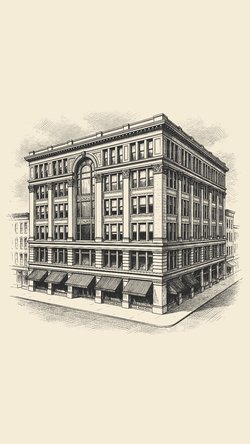
A Store On Wyoming Avenue
City preservation records place the Globe Store’s beginning in 1878, when John Cleland, John Simpson, and David Taylor opened a one-floor shop at 121 and 123 Wyoming Avenue. The business started as a dry-goods store but grew around a newer kind of retailing: fixed prices, ready-made goods, and merchandise arranged in large display windows rather than negotiated across a counter.
The building most Scrantonians remember came later. The Globe Store Building at 123 Wyoming Avenue is listed by the city’s Historical Architectural Review Board as a 1906 stone building designed by Edward Langley, with a Neoclassical and Chicago School exterior. By then, the store had already made Wyoming Avenue its address and downtown Scranton its market.
Department Store Years
The Globe expanded with the city around it. By the 1950s, the city landmark survey describes it as Scranton’s largest department store, large enough that its 75th anniversary became a local event. The store sold ready-made clothing and household goods to shoppers whose parents and grandparents had known retail as a slower, more custom trade.
In 1956, the company pushed deeper into the block, extending the store back to Penn Avenue. That expansion added a 500-car garage and a larger restaurant, giving shoppers a reason to stay downtown for more than a single purchase.
The Holiday Store
For many local shoppers, the Globe was measured in December. Former employees and residents remembered its Wyoming Avenue windows, its gift boxes and shopping bags, and the holiday displays that filled the old store after Thanksgiving. A 2015 Times Leader story on a nostalgia exhibit at 123 Wyoming Avenue described collected Globe items, display-window decorations, music, Santa, and local residents returning to the building more than 20 years after the store closed.
Keystone Edge recorded the mechanics behind the spectacle. Trees used on the facade began as Arbor Day seedlings distributed to Scranton schoolchildren, then returned years later when residents donated them back to the store. The Globe arranged a crane and flatbed to bring them downtown, fastening them to eyebolts set into the granite blocks along the second floor.
Competition And Debt
Suburban shopping changed the downtown store’s position. The city landmark survey points to the opening of Viewmont Mall in the 1960s as a new source of competition. Wanamaker’s purchased the Globe from the Cleland-Simpson Company in 1968, and the store later passed to Globe Management in 1987.
The 1993 opening of the Steamtown Mall was supposed to help pull shoppers back downtown. Instead, the Globe became an outlying anchor linked across Lackawanna Avenue by a pedestrian bridge. Keystone Edge reported that the bridge failed to solve the store’s problems as mall anchors changed, legal and financial troubles grew, and the Globe entered bankruptcy just after New Year’s Day in 1994.
Closing Day
On Thursday, January 27, 1994, Globe President Edward G. Rossi gathered employees at 10 a.m. and announced the store was closing immediately. The next day’s Times Leader reported that the downtown fixture owed $1 million to the city of Scranton and more to PNC Bank, which had taken control of the business and its merchandise.
The closing put hundreds of employees out of work. The Times Leader estimated more than 400 workers were affected, while PNC kept between 50 and 60 people for inventory, clerical work, and security. For a store that had spent more than a century training Scranton shoppers to look downtown first, the end came as a bank-controlled shutdown rather than a planned farewell.
County Offices At The Globe
The retailer’s end left a large downtown building available for another use. In April 2016, Lackawanna County commissioners voted to enter a $1.3 million purchase agreement for the former Globe Store at 123 Wyoming Avenue, intending to consolidate several county offices into one central location. A Times Leader report noted that the building had most recently been occupied for about 15 years by Diversified Information Technologies before that company left in 2014.
Keystone Edge described the reuse project as a six-story, 250,000-square-foot building that had been largely vacant since 2014. The county planned to consolidate operations spread across eight locations, with a projected cost of $17 million and as many as 700 employees working from the renovated center. The Lackawanna County Controller’s 2019 annual auditing report says the building had been renamed Lackawanna County Government Center at The Globe, relocation began in December 2018, and scheduled office moves were complete by the end of January 2019.
Company Timeline
1878
John Cleland, John Simpson, and David Taylor open a one-floor store at 121 and 123 Wyoming Avenue
1906
Globe Store Building constructed at 123 Wyoming Avenue; Edward Langley is listed as architect
1950s
The Globe becomes Scranton's largest department store
1956
Expansion extends the store back to Penn Avenue and adds a 500-car garage and larger restaurant
1968
Wanamaker's purchases the store from the Cleland-Simpson Company
1987
Ownership passes to Globe Management
1993
The Steamtown Mall opens across Lackawanna Avenue with a pedestrian bridge to the Globe
1994-01-27
The store closes to shoppers after PNC Bank takes control of the business
2016
Lackawanna County enters a $1.3 million agreement to purchase the former Globe building
2019-01
Scheduled county office relocations to the Government Center at The Globe are complete
Sources & Further Reading
- Historic Scranton: Downtown Scranton Landmark Buildings and Historic Districts, City of Scranton Historical Architectural Review Board (2016)
- Bringing the Globe Store in downtown Scranton back to life, Elise Vider (2017)
- Scranton's Globe Store Shuts Doors, Charles H. Bogino (1994)
- Memories of The Globe Store generates sentiment from different generations of Scranton shoppers, Times Leader (2015)
- Lackawanna County enters agreement to purchase The Globe building for consolidation of government offices, Times Leader (2016)
- Annual Auditing Activity Report 2019, Lackawanna County Controller's Office (2019)