Origins at Slocum Hollow
In August 1840, William Henry, a New Jersey speculator, led a surveying party into northeastern Pennsylvania’s Lackawanna Valley. Accompanying him were his son-in-law Selden T. Scranton, Selden’s brother George W. Scranton, and businessman Sanford Grant. In the ravines around Nay Aug Falls, they found abundant outcroppings of anthracite coal, iron ore, and limestone. The reliable flow of Roaring Brook promised water power.
Henry had been experimenting with using anthracite coal in iron production since 1838. His father-in-law had successfully used a hot-blast technique at Oxford Furnace in New Jersey in 1835. The partners purchased 503 acres near the five-house hamlet of Slocum Hollow. On September 11, 1840, they broke ground on their first blast furnace.
The venture was called Scranton, Grant & Company. Henry lacked the capital to fund operations alone, so the Scranton brothers and Grant provided the financing. The first hot blast was attempted on October 9, 1841. It failed. A second attempt on October 25 lasted only four days before the furnace went cold again.
The Nail Factory Failure
By 1843, the company had built a nail factory about 1,000 yards upstream from the furnaces. The facility included a rolling mill, five reverberatory furnaces, twenty nail-making machines, and one spike machine. But the iron proved too brittle for nails. Production costs exceeded market prices. The partners faced bankruptcy.
The Scrantons needed a new product. In 1846, they learned that the New York & Erie Railroad had a contract with New York State to build 130 miles of track from Port Jervis to Binghamton. English manufacturers hesitated to supply the rails. George Scranton traveled to New York City and persuaded the Erie’s board of directors to give his struggling company a contract for 12,000 tons of T-rails over two years.
The Scrantons had never made railroad rails. They bought machinery from Philadelphia, hired skilled workers, and converted the nail factory into a rolling mill. On July 23, 1847, the first T-rails rolled off the line at Scranton. They were among the earliest rails manufactured in the United States.
Reorganization and Rapid Growth
The rail contract saved the company. Orders multiplied as railroads spread across the nation. By 1850, the works included blast furnaces, a rolling mill, a nail factory, and a steel-rail works. The partners added three more anthracite furnaces between 1848 and 1852.
In 1853, the company reorganized under a special Pennsylvania charter as the Lackawanna Iron and Coal Company. Capital doubled to $800,000. The new entity incorporated coal mining assets alongside its four anthracite furnaces, rolling mill, foundry, and related facilities.
Within a year of reorganization, company assets had expanded to include three blast furnaces, a puddling mill, a foundry, two blacksmith shops, two carpentry shops, a sawmill, a gristmill, a company store, 200 worker dwellings, a boarding house, iron ore mines, coal mines, a tavern, and a hotel. A fifth blast furnace was completed by 1857, with the furnaces linked so they could share the same hot-blast machinery.
Moses Taylor Takes Control
The Panic of 1857 threatened to crush the company. Moses Taylor, a New York banker and one of the wealthiest men in America, saw opportunity. Taylor had been investing in coal lands and railroads in the region since 1853. During the panic, he purchased enough Lackawanna Iron and Coal stock to gain controlling interest.
Taylor also controlled the Delaware, Lackawanna & Western Railroad, which hauled anthracite coal from the valley to New York City. By combining the iron works with the railroad, Taylor created an integrated industrial empire. His National City Bank of New York provided the capital for expansion. Taylor would remain the dominant financial force behind the company until his death in 1882.
The Death of George Scranton
George W. Scranton drove himself relentlessly during the company’s early years. The strain of the 1840s left him with chronic health problems. He entered politics, winning election to Congress as a Republican in 1858. He served in the 36th Congress from March 4, 1859, representing Pennsylvania’s 12th district.
On March 24, 1861, just shy of his fiftieth birthday, George Scranton died at his home in the city that bore his name. He was early in his second congressional term. His cousin Joseph Hand Scranton, who had been providing financial backing from Georgia since 1848 and had risen to superintendent, became president of the company.
Civil War Expansion
The Civil War created insatiable demand for iron. Railroads needed rails to move troops and supplies. The Union Army needed cannon, equipment, and machinery. Lackawanna Iron and Coal expanded production to meet wartime needs.
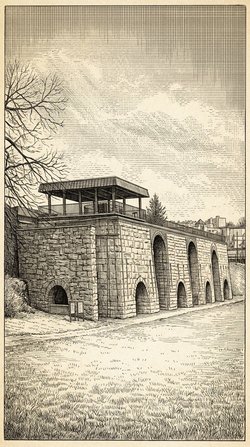
By 1865, the company had achieved the largest iron production capacity in the United States. Annual output reached 60,000 tons of rails. The five stone blast furnaces along Roaring Brook ran continuously, consuming anthracite coal from the company’s own mines and converting iron ore into the pig iron that fed the rolling mills.
Joseph Hand Scranton led the company through the war years and the postwar boom. He served as president until his death in 1872. Frederick Hitchcock later examined company records and found that between 1867 and 1870, Lackawanna Iron and Coal generated profits exceeding $4.1 million.
The Second Generation
William Walker Scranton, Joseph’s son, had grown up in the iron business. Born in 1844 in Augusta, Georgia, he came north with his family as a child. At age 23, he became superintendent of one of the company’s steel mills. In 1867, he took over as superintendent of the entire works. Four years later, he became assistant to the president and took charge of all manufacturing operations.
William Walker Scranton pushed for technological innovation. The company had been producing iron since its founding. But the future belonged to steel. In the 1870s, W.W. Scranton investigated the Bessemer process during trips to Europe. He convinced Moses Taylor and the other investors to adopt the new technology.
On October 23, 1875, the first Bessemer “blow” occurred at the Scranton works. Molten steel poured from the converter into molds. On December 29, the first Bessemer steel rolled through the mill. Lackawanna Iron and Coal had entered the steel age.
Peak Production
By 1880, the furnaces produced 125,000 tons of pig iron annually. The rolling mill and foundry converted the iron into T-rails and other products. The company was the second-largest producer of iron in the United States.
But William Walker Scranton wanted more. In 1881, he proposed major expansion. The board of directors rejected his plan. Scranton quit and formed the Scranton Steel Company with his brother Walter. Within a decade, Scranton Steel’s two six-ton Bessemer converters could produce 250,000 tons of ingots per year and roll 220,000 tons of steel rails annually.
The competition between the two Scranton-family companies could not last. On January 9, 1891, Lackawanna Iron and Coal merged with Scranton Steel to form the Lackawanna Iron and Steel Company. The merger created the third-largest steelworks in the nation, though it also generated $1.2 million in debt. The combined company paid off the debt within a year.
By 1894, Lackawanna Iron and Steel manufactured 500,000 tons of steel rail annually, one-sixth of total national output. The company employed 3,000 workers in Scranton.
Building a City
The company’s growth transformed the Lackawanna Valley. The five-house hamlet of Slocum Hollow was renamed Harrison, then Scrantonia in 1850, and finally Scranton in 1851. Population exploded from a few hundred in 1850 to 9,000 by 1860 and 35,000 by 1870.
Workers arrived from across Europe seeking employment in the furnaces and mines. The company built housing, stores, and infrastructure. Churches, schools, and civic institutions followed. Scranton was incorporated as a borough in 1856 and as a city in 1866, when the surrounding boroughs of Hyde Park and Providence merged with it.
The Delaware, Lackawanna & Western Railroad, controlled by the same Moses Taylor who dominated the iron company, connected Scranton to New York City and the Great Lakes. Anthracite coal flowed out; workers and capital flowed in. By the late 1880s, Scranton was one of the nation’s leading industrial centers.
Labor Tensions
The company’s workers did not share equally in the prosperity. In 1877, a nationwide railroad and industrial strike led to a bloody riot in Scranton. The violence ushered in an early Progressive city government led by Terence Powderly, himself a union leader.
In 1897, the United Mine Workers organized most workers at the company’s coal and iron mines. A successful strike in 1900 won a 10 percent wage increase. Miners struck again from May 11 to October 23, 1902, winning a second wage increase and better working conditions.
The strikes worried company management. Labor costs in Scranton were rising. The anthracite region had become a stronghold of organized labor.
The Decision to Leave
By the 1890s, Lackawanna Iron and Steel faced mounting problems in Scranton. Rich iron ore deposits in Minnesota’s Mesabi Range had shifted the economics of steel production. Ore from the Great Lakes was cheaper than ore shipped overland to northeastern Pennsylvania. Labor costs continued to climb. The company’s markets were shifting westward.
On March 23, 1899, company representatives including Walter Scranton and Henry Wehrum scouted sites near Buffalo, New York. The location offered proximity to Great Lakes shipping routes for Mesabi Range ore and access to numerous rail lines serving midwestern markets.
Construction of a massive new steel mill began at West Seneca, New York, on July 14, 1900. Nine months later, equipment started arriving from Scranton. The company dredged a ship canal and built miles of track to link the plant with railroads.
The Move to Buffalo
On February 14, 1902, the company reorganized as the Lackawanna Steel Company. On June 25, the Scranton Times announced the company’s plan to abandon its birthplace. The news stunned the city.
The Scranton plant was dismantled. Workers tore down buildings and shipped machinery to Buffalo. The company sold its Scranton property to the Lackawanna and Wyoming Valley Railroad, which scrapped the remaining equipment and demolished all structures except the oldest stone blast furnaces.
On December 23, 1902, the first shipment of iron ore arrived at the Buffalo plant. The 6,000 workers at the new facility included 2,000 who had relocated from Scranton. The company blew its first steel in early 1903. The Scranton furnaces, which had burned continuously for six decades, fell silent.
Legacy
The company that had created Scranton had abandoned it. But the city remained. A population of over 100,000 had been built on the foundation the Scrantons laid. Churches, schools, hospitals, and civic institutions served descendants of workers who had first come to labor at the furnaces.
Moses Taylor, who had financed the company’s greatest expansion, donated $250,000 at his death in 1882 to build a hospital in Scranton for his iron and coal workers. The Borough of Taylor, carved from Providence Township in 1863, bears his name.
The four stone blast furnaces that survive today along Roaring Brook are monuments to the company’s first decades. The Pennsylvania Historical and Museum Commission has managed the site since 1971 as part of the Pennsylvania Anthracite Heritage Museum complex. The ruins stand where the company first lit its furnaces in 1841 and where a city was born.
Company Timeline
1840-09-11
Construction begins on first blast furnace at Slocum Hollow
1841-10-09
First attempt to light the blast furnace
1843
Nail factory opens but produces low-quality iron
1846
Secures contract with New York & Erie Railroad for 12,000 tons of T-rails
1847-07-23
First T-rails rolled at Scranton, among the earliest in the nation
1851
Village renamed Scranton in honor of the founding family
1853
Reorganized as Lackawanna Iron and Coal Company with $800,000 capital
1855
Fifth blast furnace completed, expanding production capacity
1857
Moses Taylor gains controlling interest in the company
1861-03-24
George W. Scranton dies; Joseph Hand Scranton becomes president
1865
Achieves largest iron production capacity in the United States
1867
William Walker Scranton becomes superintendent
1872
Joseph Hand Scranton dies
1875-10-23
First Bessemer steel 'blow' at the Scranton works
1880
Furnaces produce 125,000 tons of pig iron annually
1881
William Walker Scranton leaves to found Scranton Steel Company
1891-01-09
Merges with Scranton Steel Company to form Lackawanna Iron and Steel Company
1894
Produces 500,000 tons of steel rail, one-sixth of national output
1899-03-23
Company scouts sites near Buffalo for relocation
1900-07-14
Construction begins on new plant at West Seneca, New York
1902-02-14
Reorganized as Lackawanna Steel Company
1902-12-23
First iron ore shipment arrives at Buffalo plant; Scranton furnaces fall silent
Sources & Further Reading
- Scranton Iron Furnaces, Pennsylvania Historical and Museum Commission (2024)
- The Early History of the Lackawanna Iron and Coal Company: A Study in Technological Adaptation, W. David Lewis (1972)
- Lackawanna Steel Company, Wikipedia (2025)
- Local history: Lackawanna Iron & Coal leaves Scranton, Scranton Times-Tribune (2011)
- The Scranton Story, Burton W. Folsom Jr., Foundation for Economic Education (1998)
- Moses Taylor papers, New York Public Library Archives (2024)
- Lackawanna Iron and Coal Company Furnaces, SAH Archipedia (2024)
- History of Scranton and Its People, Frederick Hitchcock (1914)