New York Investors in Pennsylvania Coal
The Pennsylvania Coal Company emerged from the same speculative fever that drove New York investors into the anthracite regions in the late 1830s. In 1838, the Pennsylvania legislature granted charters to both the Pennsylvania Coal Company and the Washington Coal Company, two separate enterprises seeking to tap the rich coal deposits of the northern anthracite field.
Irad Hawley, a wealthy New York City merchant, organized and became the first president of the Pennsylvania Coal Company. Hawley had made his fortune in the West Indies grocery trade through his firm Holmes, Hawley & Company. He saw anthracite as the fuel of the future and invested heavily in coal lands near Pittston in Luzerne County.
The challenge was transportation. The coal had to reach markets in New York City. The Delaware & Hudson Canal Company had already built a gravity railroad from Carbondale to Honesdale and a canal from there to the Hudson River. The Pennsylvania Coal Company would need its own route.
The Gravity Railroad
The Washington Coal Company, chartered the same year, began constructing a gravity railroad in 1847. The project was meant to connect the mines at Port Griffith, near Pittston, to Paupack Eddy on the Delaware & Hudson Canal, where coal could be loaded onto canal boats for the journey to New York. But the Washington company’s construction stalled.
In 1849, the Pennsylvania Coal Company absorbed the Washington Coal Company and its half-finished railroad. Company engineers completed the line in less than a year. On May 10, 1850, before dawn, the first coal car descended from Dunmore toward Hawley.
The completed Gravity Railroad ran 47 miles from Port Griffith through Dunmore, over the Moosic Mountains, and down to Hawley. The line used no locomotive power on most of its route. Gravity pulled loaded cars down inclined planes, while stationary steam engines with cables hauled empty cars back up. The loaded track stretched 46.7 miles with 12 planes; the light track ran 43.6 miles with 10 planes.
The cables themselves marked an engineering advance. Early hemp cables slipped and frayed. The company replaced them with steel cables manufactured by John Roebling, who would later design the Brooklyn Bridge. The Pennsylvania Coal Company’s railroad became one of the earliest practical applications of Roebling’s wire rope technology.
A Town Named Hawley
Paupack Eddy, where the gravity railroad met the D&H Canal, was renamed Hawleysburg in 1849 after Irad Hawley and shortened to Hawley in 1851. The Pennsylvania Coal Company laid out the streets and built a basin and boatyard for transferring coal to canal boats.
At the Hawley terminal, a Greek Revival structure served as the company’s paymaster’s house and telegraph office. The building still stands between Bingham Park and the Lackawaxen River. Coal loaded onto boats at Hawley traveled the D&H Canal to Kingston, New York, then down the Hudson River to New York City.
Irad Hawley died in 1865. His New York City mansion on Fifth Avenue, built while he was company president, later became the home of the Salmagundi Club, America’s oldest artists’ club. Washington Irving had been a frequent visitor during Hawley’s lifetime.
The Company’s Reach
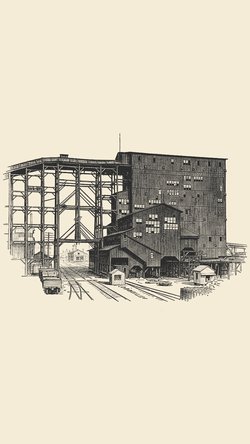
At its peak, the Pennsylvania Coal Company employed about 3,000 workers in its foundry, mines, offices, and railroad operations. The company owned collieries throughout the Pittston and Dunmore areas and processed coal through massive breakers that crushed and sorted the anthracite by size.
The gravity railroad also carried passengers. Starting in 1874, two trips ran daily between Dunmore and Hawley, taking about two hours each way. Excursion trains carried tourists to Jones Lake, later known as Lake Ariel. The passenger cars held twenty people each. One of these cars, the Pioneer Coach, is preserved outside the Hawley Public Library. Another, the Dobson, is displayed at Nay Aug Park in Scranton.
By the 1880s, steam locomotives could haul heavier loads more efficiently than gravity systems. In 1885, the Pennsylvania Coal Company abandoned its gravity railroad. The Erie and Wyoming Valley Railroad converted the route to a conventional steam-powered standard-gauge line.
The Avondale Disaster
On September 6, 1869, a fire at the company’s Avondale Colliery killed 110 workers. The mine, located in Plymouth Township near Wilkes-Barre, had a single shaft that served as both entry and ventilation. The coal breaker sat directly above the shaft opening.
A furnace used to ventilate the mine ignited the wooden shaft lining. The fire spread to the breaker overhead. Within minutes, flames blocked the only exit. Rescue workers tried repeatedly to descend but were driven back by smoke and heat. Two volunteers died attempting to reach the trapped miners.
When rescuers finally entered the mine two days later, they found all 110 workers dead from suffocation. The victims included five boys between twelve and seventeen years old. Between 70 and 80 percent of the dead were Welsh immigrants. The disaster left 72 widows and 158 fatherless children.
Public outrage forced legislative action. In 1870, Pennsylvania’s General Assembly passed the first comprehensive mine safety law in the state’s history. The act required every mine to have at least two openings for escape and ventilation. It established the position of mine inspector and set standards for shaft construction and ventilation. England had already banned the practice of building breakers above mine shafts. Pennsylvania only followed after Avondale.
The disaster also drove workers to organize. The Workingmen’s Benevolent Association, an early miners’ union led by John Siney, saw membership surge in the months following Avondale. The tragedy remained the deadliest single incident in the history of American anthracite mining.
Under the Erie Railroad
In 1901, the Erie Railroad acquired a majority of Pennsylvania Coal Company stock. The coal company became a subsidiary of the railroad, supplying anthracite to fuel Erie’s locomotives and generating freight revenue for the railroad’s lines.
The Erie obtained ownership but allowed the Pennsylvania Coal Company to operate largely independently for decades. The company continued to mine coal and harvest lumber from thousands of acres of property. It processed and marketed these products through its own facilities.
Construction on the Underwood Colliery, on the Throop-Olyphant border, began in 1912. The mine went into production on April 28, 1914. The Pennsylvania Coal Company built Underwood Village nearby to house workers and their families. The colliery served multiple coal veins: the Rock vein at 108 inches, Pittston at 72 inches, Marcy at 81 inches, Clark at 84 inches, and two Dunmore veins at 52 and 50 inches.
Decline and Dissolution
Anthracite production peaked nationally in 1917 at 99.6 million tons. The industry employed 180,000 men in Pennsylvania at its height during World War I. But oil and natural gas gradually displaced anthracite as a heating fuel. Production declined steadily through the mid-twentieth century.
In 1960, the Erie Railroad merged with the Delaware, Lackawanna & Western Railroad to form the Erie Lackawanna Railway. The Pennsylvania Coal Company remained a subsidiary. But the merged railroad struggled financially, entering bankruptcy in 1972.
The Pennsylvania Coal Company’s corporate records end in 1971. In September 1978, attorney Michael Evans, trustee for the bankrupt Erie Lackawanna Railway, put the remaining Pennsylvania Coal Company properties in Lackawanna County up for sale. The holdings totaled close to 4,000 acres, located mostly in Throop, Dunmore, and Olyphant.
The Pennsylvania State Archives holds 42 cubic feet of Pennsylvania Coal Company corporate records, mostly minutes and financial accounts, spanning from the company’s 1838 charter to 1971. Additional records were donated to the Anthracite Heritage Museum. The gravity railroad passenger car at Nay Aug Park and the Hawley paymaster’s house are among the few physical remnants of an enterprise that once moved mountains of coal from the northern field to the cities of the East.
Company Timeline
1838
Pennsylvania Coal Company chartered by Pennsylvania legislature
1838
Washington Coal Company also chartered; begins constructing gravity railroad
1847
Washington Coal Company's gravity railroad construction stalls
1849
Pennsylvania Coal Company merges with Washington Coal Company
1850-05-10
First coal car descends from Dunmore to Hawley on the Gravity Railroad
1850
Gravity Railroad completed; 47 miles from Port Griffith (Pittston) to Hawley
1869-09-06
Avondale Mine disaster kills 110 workers
1870
Pennsylvania Mine Safety Act passes in response to Avondale
1874
Passenger service begins on Gravity Railroad as tourist attraction
1885
Gravity Railroad abandoned; converted to steam-powered standard-gauge line
1901
Erie Railroad acquires majority stock in Pennsylvania Coal Company
1912
Construction begins on Underwood Colliery in Throop-Olyphant
1914-04-28
Underwood Colliery begins production
1960
Erie merges with Delaware, Lackawanna & Western to form Erie Lackawanna Railway
1971
Pennsylvania Coal Company corporate records end
1978
Remaining properties in Lackawanna County sold as part of Erie Lackawanna bankruptcy
Sources & Further Reading
- Pennsylvania Coal Company Records, 1838-1971, Pennsylvania State Archives (2024)
- Gravity Railroad, Wayne County Historical Society (2024)
- Avondale Mine Disaster, Wikipedia (2025)
- Local historians preserve Gravity Railroad history, Scranton Times-Tribune (2016)
- Pennsylvania Gravity Railroad Historical Marker, ExplorePAHistory.com (2024)
- 45 Years Ago: Former coal and railroad assets put up for sale in Lackawanna County, Scranton Times-Tribune (2023)
- History of Hawley, Historical Marker Database (2024)
- Irad Hawley: His Name and Face Live On, Old Ridgefield (2020)