Biography
A Namesake and a Farm Boy
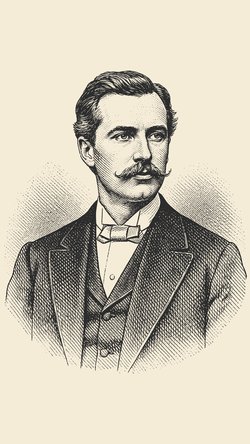
Charles Sumner Woolworth was born August 1, 1856, on a farm in Rodman, Jefferson County, New York. His parents, John Hubbell Woolworth and Fanny McBrier, named him after Charles Sumner, the Massachusetts senator and antislavery leader. The family called him “Sum” for the rest of his life.
His older brother Frank Winfield Woolworth, born in 1852, shared the same upbringing of farm chores and rural schooling in northern New York. Neither brother showed early enthusiasm for agriculture. Both gravitated toward shopkeeping.
Frank’s Experiment
Frank Woolworth opened his first “Great Five Cent Store” on February 22, 1879, in Utica, New York. It failed within weeks. He tried again on June 21, 1879, in Lancaster, Pennsylvania, adding ten-cent goods to the inventory. The Lancaster store held.
Frank moved quickly to expand and put his younger brother to work. Sum’s first retail position was managing a Woolworth store in Harrisburg, Pennsylvania, in 1879. The experience gave him a working knowledge of the five-and-ten model before he struck out on his own.
125 Penn Avenue
On November 6, 1880, Sum opened the “5-cent & 10-cent Woolworth Bro’s Store” at 125 Penn Avenue in Scranton. The store was among the first retail locations in the country to carry the formal “5 & 10” branding that would define the industry for decades.
Scranton in 1880 was a coal and iron boomtown with a growing downtown commercial district. Sum’s Penn Avenue store sat in the middle of it. He adopted practices that were uncommon for the era: electric lighting, glass display windows that let pedestrians see merchandise from the sidewalk, and open shelving that allowed customers to handle goods before buying. These were not gimmicks. They were deliberate methods to increase foot traffic and reduce the need for sales clerks behind counters.
Growth on Lackawanna Avenue
The Penn Avenue location outgrew itself within a few years. Sum moved the operation to 319 Lackawanna Avenue, Scranton’s main commercial thoroughfare, where the store had more floor space and heavier pedestrian traffic.
From this base, Sum built C.S. Woolworth & Co. into a chain of 15 stores spread across the Northeast. He ran the business from Scranton, training store managers in customer service techniques and standardized merchandising. His stores were known for bright lighting and orderly displays. A later Woolworth location occupied the 400 block of Lackawanna Avenue, where its red metal fascia remained visible into the late twentieth century.
The Five-and-Ten Model
Sum and Frank Woolworth operated separate companies through the 1880s, 1890s, and 1900s, but they shared the same retail philosophy. The five-and-ten model worked on volume. Individual items carried slim margins, sometimes just a penny or two of profit. Revenue came from selling enormous quantities of cheap goods: kitchenware, candy, stationery, toys, ribbons, and household tools.
Sum contributed specific innovations to this formula. He emphasized self-service methods that let customers browse freely rather than waiting for a clerk to retrieve items from behind a counter. He invested in employee training, particularly for store managers, and insisted on consistent presentation across all 15 of his locations.
The 1912 Merger
On January 31, 1912, six separate five-and-ten chains combined into the F.W. Woolworth Company in a $65 million deal. The merger brought together F.W. Woolworth’s 319 stores, S.H. Knox’s 98, F.M. Kirby’s 96, E.P. Charlton’s 35, C.S. Woolworth’s 15, and W.H. Moore’s 2. The combined company controlled 596 stores.
Sum’s 15-store chain was the smallest of the major partners, but the Woolworth name sat on the door. Frank became president of the new company. Sum took a board seat and continued operating from Scranton. The merger created the largest retail chain in the world at the time.
Chairman of the Board
Frank Woolworth died on April 8, 1919. Sum, then 62 years old, succeeded his brother as Chairman of the Board of the F.W. Woolworth Company. He held the position for 25 years, steering the company through the 1920s expansion, the Great Depression, and the early years of World War II.
He stepped down on February 9, 1944, at the age of 87, accepting the title of Honorary Chairman. By that point the Woolworth chain had grown to thousands of stores across North America and Europe.
The Jefferson Avenue Mansion
In 1910, Sum commissioned a French Renaissance mansion at 520 Jefferson Avenue in Scranton’s Hill Section. He hired Lansing Holden, a New York City architect, to design the house, and Theo Hofstatter & Co. to handle the interior decoration.
The finished residence covered 8,333 square feet with five bedrooms and five bathrooms. An adjoining carriage house added another 3,000 square feet. The house reflected Sum’s wealth but also his commitment to Scranton as his permanent home. He had been living in the city for 30 years by the time the mansion was completed.
The house changed hands multiple times after the Woolworth era. The artist Hunt Slonem owned it for a period. In 2021, Yoel Weiss purchased the property for $999,999. It now operates as the Weiss Torah Center.
Family Life
Sum married Anna Elizabeth Ryals on June 2, 1886, in Utica, New York. They had three children: Ethel Mae, Fred Everett, and Richard Wesley. Anna died in 1913. Sum never remarried and lived the remaining 34 years of his life as a widower.
Civic and Business Interests
Beyond retail, Sum held positions across Scranton’s business community. He served as Vice-President of the People’s National Bank of Scranton and sat on the boards of the Scranton Trust Company, the United States Lumber Company (headquartered in Scranton), and the Mississippi Central Railroad. He also contributed to the Women’s Domestic Institute.
These directorships connected him to Scranton’s banking, timber, and transportation industries during the decades when the city served as a regional commercial center.
Death and Burial
Charles Sumner Woolworth died in his sleep on January 7, 1947, at the age of 90. He had lived in Scranton for 67 years, arriving as a 24-year-old shopkeeper and remaining through two world wars, the rise and fall of anthracite coal, and the transformation of American retail.
He was buried in the Woolworth Mausoleum at Dunmore Cemetery in Dunmore, Lackawanna County, adjacent to Scranton. In 2016, the Scranton Times-Tribune named him to its list of “150 People Who Made Scranton Great.”
Timeline
1856-08-01
Born in Rodman, Jefferson County, New York, to John Hubbell Woolworth and Fanny McBrier
1879
Manages brother Frank's store in Harrisburg, Pennsylvania, his first retail position
1880-11-06
Opens '5-cent & 10-cent Woolworth Bro's Store' at 125 Penn Avenue, Scranton
1886-06-02
Marries Anna Elizabeth Ryals in Utica, New York
1910
Commissions French Renaissance mansion at 520 Jefferson Avenue, designed by Lansing Holden
1912-01-31
C.S. Woolworth's 15 stores merge with five other chains to form the F.W. Woolworth Company with 596 stores
1913
Wife Anna dies
1919-04-08
Brother Frank dies; Sum becomes Chairman of the Board of F.W. Woolworth Company
1944-02-09
Steps down as Chairman at age 87, becomes Honorary Chairman
1947-01-07
Dies in his sleep at age 90; buried in Woolworth Mausoleum, Dunmore Cemetery
Sources & Further Reading
- Charles Sumner Woolworth, Wikipedia (2024)
- F. W. Woolworth Company, Wikipedia (2024)
- Biography of Charles Sumner Woolworth, Woolworths Museum (2024)
- The $65m Merger That Created F.W. Woolworth Co., Woolworths Museum (2024)
- Charles Sumner Woolworth Memorial, Find a Grave (2024)
- Charles S. Woolworth House, 520 Jefferson Avenue, SAH Archipedia (2024)