Biography
Small-Town Ohio to Chicago
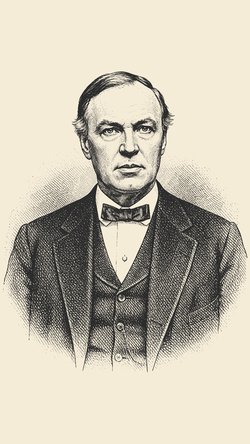
Clarence Seward Darrow was born April 18, 1857, near Kinsman, Ohio, the fifth of eight children. His father Amirus was a carpenter and the village’s most visible agnostic, a trait Clarence inherited and carried into public life. Darrow spent one year at Allegheny College in Meadville, Pennsylvania, then one year at the University of Michigan Law School before passing the Ohio bar in 1878. He practiced in small Ohio towns for a decade.
In 1888, Darrow moved to Chicago. Within two years he was appointed city corporation counsel and became general attorney for the Chicago and North Western Railway. It was a comfortable railroad career, and he abandoned it in 1894 to defend Eugene V. Debs, president of the American Railway Union, during the Pullman Strike. The choice cost Darrow his corporate salary but established him as the country’s most prominent labor attorney.
Partnership with Altgeld
From 1897 to 1902, Darrow practiced law in partnership with John Peter Altgeld, the former governor of Illinois who had pardoned the surviving Haymarket defendants. Altgeld died in 1902, the same year Darrow took on the case that would bring him to Scranton.
Hired for the Coal Strike
The 1902 anthracite coal strike shut down the mines of northeastern Pennsylvania for 163 days. After President Theodore Roosevelt created the Anthracite Coal Strike Commission in October to arbitrate the dispute, the United Mine Workers of America needed an attorney who could match the operators’ legal teams. Henry Demarest Lloyd, the reform journalist, recommended Darrow to UMWA president John Mitchell. Darrow accepted for a fee of $10,000.
The operators were represented by a roster of corporate attorneys led by George F. Baer, president of the Philadelphia and Reading Coal and Iron Company. Baer had spent the summer publicly insisting that God had entrusted the nation’s property to its business leaders. Darrow would spend the winter arguing otherwise.
Three Months in Scranton
The commission began hearings at the Lackawanna County Courthouse on November 14, 1902. For the next three months, Darrow worked out of Scranton, preparing witnesses, reviewing mine records, and building a case that the anthracite industry’s wealth rested on the broken bodies of its workers.
Darrow called miners, breaker boys, and their families to the stand. The testimony was specific. Workers described ten-hour days underground for wages that barely covered rent at company houses. They explained how coal was weighed on company scales they had no power to check. Injured miners described being sent home without compensation.
The breaker boys received particular attention. Children as young as nine sorted coal in the breakers, hunched over chutes for ten hours a day. Darrow questioned these boys on the stand and let the commissioners see their hands, scarred and blackened from the work. He asked whether a society that sent children into the breakers instead of schools could call itself civilized. The testimony forced child labor into the national conversation in a way that statistics alone had not.
Cross-Examining the Operators
Darrow was equally effective in cross-examination. He pressed mine superintendents on their safety records and wage calculations. He exposed the gap between what operators claimed they paid and what miners actually received after deductions for powder, tools, and company store charges. He questioned the Coal and Iron Police about their treatment of strikers and their families.
The full record ran to 10,047 legal-sized pages across 50 volumes. A total of 558 witnesses testified before the proceedings ended.
The Closing Argument
From February 9 to February 13, 1903, the attorneys delivered their closing arguments. Baer spoke for the operators. Darrow closed for the miners on February 13 with a sustained argument that walked the commissioners through months of pay stubs, injury records, and testimony. He framed the case not as a dispute over percentages but as a question about the conditions under which 147,000 people and their families lived.
On March 18, 1903, the commission issued its findings. Miners received a 10 percent wage increase and a reduction from ten-hour to nine-hour workdays. They won the right to elect their own checkweighmen to verify tonnage. The commission also created a Board of Conciliation to handle future grievances. The award fell short of the union’s original demands of 20 percent and an eight-hour day, but it was the first time the federal government had compelled arbitration rather than sending troops to break a strike.
After Scranton
Darrow returned to Chicago and continued taking cases that put him at the center of national controversies. In 1907 he defended William “Big Bill” Haywood, the Western Federation of Miners leader accused of assassinating Idaho’s former governor, and secured an acquittal. In 1911 he took on the McNamara brothers, accused of bombing the Los Angeles Times building. That case ended badly when the brothers confessed, and Darrow himself was tried twice for allegedly bribing jurors. He was acquitted both times but his reputation suffered.
By the 1920s, Darrow had rebuilt his standing. In 1924 he defended Nathan Leopold and Richard Loeb, two University of Chicago students who had murdered a fourteen-year-old boy. Darrow’s twelve-hour plea against the death penalty persuaded the judge to sentence them to life in prison. A year later, in 1925, he traveled to Dayton, Tennessee, to defend John Scopes, a schoolteacher charged with teaching evolution. Darrow lost the case on its facts but used his cross-examination of prosecutor William Jennings Bryan to argue against anti-evolution statutes in front of a national audience.
Final Years
Darrow largely retired from practice in the late 1920s. He spent his last years writing, lecturing, and debating. He published his autobiography, “The Story of My Life,” in 1932. He died in Chicago on March 13, 1938, at eighty years old. His ashes were scattered in the lagoon at Jackson Park, near the site of the 1893 World’s Columbian Exposition.
Timeline
1857-04-18
Born near Kinsman, Ohio
1878
Admitted to the Ohio bar after one year at University of Michigan Law School
1888
Moved to Chicago
1894
Resigned railway position to defend Eugene V. Debs during Pullman Strike
1902-11-14
Anthracite Coal Strike Commission hearings begin at Lackawanna County Courthouse in Scranton
1903-02-13
Delivered closing argument for the miners before the commission
1903-03-18
Commission awards miners 10% wage increase and 9-hour workday
1907
Defended 'Big Bill' Haywood; secured acquittal
1924
Defended Leopold and Loeb in Chicago murder trial
1925
Argued Scopes 'Monkey Trial' in Tennessee
1938-03-13
Died in Chicago at age 80
Sources & Further Reading
- The Anthracite Coal Strike, Clarence Darrow Digital Collection, University of Minnesota Law Library (2023)
- Anthracite coal strike of 1902, Wikipedia (2024)
- Clarence Darrow, Encyclopaedia Britannica (2024)
- The Coal Strike of 1902: Turning Point in U.S. Policy, Jonathan Grossman, U.S. Department of Labor (1971)
- Anthracite Coal Strike of 1902, Michael Hannon (2010)
- Clarence Darrow (1857-1938), Douglas O. Linder, Famous Trials (2020)
- Clarence Darrow, Wikipedia (2024)