Biography
Early Life and Career
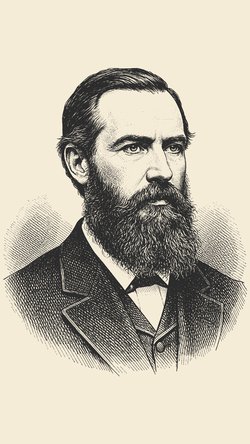
Elliot S.M. Hill was born on December 6, 1820, in Carmel, Putnam County, New York. His father, Noah Hill, was born in 1793 and died in 1867. His mother, Priscilla Miller Hill, lived from 1797 to 1877.
Hill trained as a lawyer and established a legal practice in the Scranton area before the Civil War. By the mid-1860s, he had also entered the newspaper business, founding the Lackawanna Register in 1865. The paper was later renamed the Scranton Daily Register. Hill owned and edited the publication until the summer of 1868.
First Mayor of Scranton
On April 23, 1866, the Pennsylvania legislature approved the consolidation of the boroughs of Scranton, Hyde Park, and Providence into a single incorporated city. The new municipality was divided into twelve wards. By April 1867, the city’s estimated population exceeded 55,000 based on the ratio of taxables to non-taxables on the assessment rolls.
Hill ran for the newly created office of mayor as a Democrat and won. He took office as the first person to hold the title of Mayor of Scranton.
A City Under Construction
The consolidation joined three separate boroughs into one city. Hill had to govern a municipality that was, in practical terms, three distinct communities stitched together by a charter.
His administration organized the city’s fire protection, bringing the existing volunteer fire companies under a single municipal structure. T. Mayo Bartlett served as chief of police during Hill’s tenure.
Industrial Scranton in the Late 1860s
The city Hill governed sat at the center of northeastern Pennsylvania’s iron and coal economy. The Lackawanna Iron and Coal Company, founded by George Scranton and his partners in the 1840s, had emerged from the Civil War with the largest iron production capacity in the United States. The company operated furnaces and rolling mills along Roaring Brook.
The Delaware, Lackawanna and Western Railroad maintained its headquarters in Scranton, running coal and freight between the anthracite fields and markets in New York and New Jersey. Railroad expansion after the war accelerated demand for both iron rails and anthracite fuel.
By the 1870 census, Scranton’s population had reached 35,092, confirming the rapid growth that characterized Hill’s years in office.
Labor Tensions
Hill’s mayoralty coincided with the beginning of labor unrest in the anthracite region. The Pennsylvania legislature had passed the Coal and Iron Police Act in 1866, authorizing private police forces employed by coal and railroad companies. In 1868, miners in Schuylkill County organized a six-week strike over wages, led by the newly formed Workingmen’s Benevolent Association. These conflicts continued well after Hill left office, escalating through the mid-1870s.
After Office
Hill married Mary Newberry. He left the mayor’s office in 1869, succeeded by Republican William N. Monies. He died on September 29, 1871, at the age of 50. He is buried in Troy, Bradford County, Pennsylvania.
Timeline
1820-12-06
Born in Carmel, Putnam County, New York
1865
Began publishing the Lackawanna Register in Scranton
1866-04-23
Scranton incorporated as a city, consolidating the boroughs of Scranton, Hyde Park, and Providence into twelve wards
1866
Elected first Mayor of Scranton as a Democrat
1868
Ceased managing the Scranton Daily Register
1869
Left office; succeeded by Republican William N. Monies
1871-09-29
Died at age 50
Sources & Further Reading
- History of the Lackawanna Valley, H. Hollister (1903)
- History of the City of Scranton and Directory for 1867-1868, Andrew B. Galatian (1867)
- History of Luzerne, Lackawanna, and Wyoming Counties, Pa., W.W. Munsell & Co. (1880)
- Elliot S.M. Hill, The Political Graveyard (2024)
- Priscilla Hill Memorial, Find A Grave (2019)