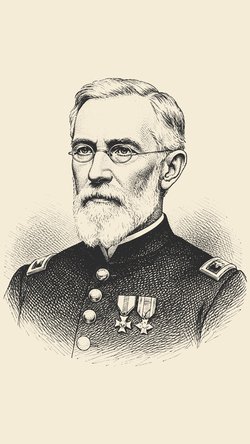
Biography
Early Life
Ezra Hoyt Ripple was born February 14, 1842, in Mauch Chunk (present-day Jim Thorpe), Carbon County, Pennsylvania, the son of Silas and Elizabeth Harris Ripple. He was twenty years old when the Civil War drew him into uniform for the first time.
Three Enlistments
Ripple enlisted three separate times during the war. His first stint was brief: he mustered into Company I, 13th Pennsylvania Militia, on September 12, 1862, and was discharged two weeks later in Harrisburg. A second enlistment followed the next summer, from June 29 to August 1, 1863, as a Sergeant in Company H, 30th Pennsylvania Infantry.
On March 24, 1864, he signed up a third time in Hyde Park, a Scranton neighborhood, joining Company K of the 52nd Pennsylvania Volunteer Infantry as a Private. It was this final enlistment that carried him south to Charleston and into Confederate captivity.
Capture and Andersonville
On July 3, 1864, Ripple’s regiment attacked Fort Johnson on James Island near Charleston, South Carolina. The Union troops briefly penetrated the fort before a Confederate counterattack overwhelmed them, and 135 men were captured, Ripple among them.
He arrived at Andersonville Prison in Georgia the next day, July 4. The stockade had been built for 10,000 men, but an estimated 25,000 were packed inside it by the time Ripple walked through the gates.
Florence Stockade
On September 13, 1864, Ripple was transferred to Florence Stockade in South Carolina, where conditions were equally grim. To survive the winter, he and three comrades dug a three-foot pit in the ground and used it as shelter.
Ripple was a fiddle player, and the skill kept him alive. At Andersonville he traded performances for extra food; at Florence he put together an inmate orchestra. Sometime in February 1865 he tried to escape, but prison dogs ran him down and he was dragged back. He was finally released on March 1, 1865, and received an honorable discharge at Camp Parole in Annapolis, Maryland, on June 30 of that year.
Scranton and Business Life
After the war Ripple settled in Scranton, where he went to work in the crockery business of Colonel Frederick Hitchcock. He eventually moved over to bookkeeping for Congressman William Connell and stayed with Connell’s mining and coal firm for more than forty years.
Citizens’ Corps and the National Guard
When the Great Railroad Strike hit Scranton in 1877, Ripple was elected captain of the Citizens’ Corps, a civilian militia organized to keep order in the city. The corps was later folded into the 13th Regiment of the Pennsylvania National Guard, and Ripple stayed with the Guard from 1877 to 1895, receiving his colonel’s commission in 1888. The title stuck. He was “Colonel Ripple” for the rest of his life.
County Treasurer and Mayor
In 1879 Ripple won election as the first Treasurer of Lackawanna County, and seven years later, in 1886, he became Mayor of Scranton, serving a four-year term through 1890.
His most visible act as mayor came on May 1, 1887, when he signed legislation authorizing the acquisition of land for Scranton City Hall. The building’s cornerstone still bears his name.
Postmaster
President McKinley appointed Ripple as Scranton’s Postmaster in 1901, and both Theodore Roosevelt and William Howard Taft reappointed him, so he held the position until his death. That same year he published “History of Scranton Postoffice” through Tribune Publishing Company.
The Memoir
Through the 1890s Ripple gave public lectures on his prison experiences, illustrated with magic lantern slides based on drawings he commissioned from the Civil War artist James E. Taylor. In 1902 he sat down and wrote a full account of his imprisonment, titling it “Dancing Along the Deadline” and intending it only for his wife and children.
The manuscript sat unpublished for nearly a century until historian Mark A. Snell edited it for Presidio Press in 1996 as “Dancing Along the Deadline: The Andersonville Memoir of a Prisoner of the Confederacy.”
Andersonville Memorial
Governor William Stone appointed Ripple to the Pennsylvania Andersonville Memorial Commission, which placed a monument at Andersonville National Cemetery honoring the 1,849 Pennsylvanians buried there.
Death
Ripple died in Scranton on November 19, 1909, at the age of 67, and was buried at Dunmore Cemetery in Lackawanna County. His wife, Sarah H. Hackett Ripple, survived him by seven years. They had four children: Hannah Hamblen, Ezra Hoyt Jr., Jessica, and Susan E. Ripple.
Timeline
1842-02-14
Born in Mauch Chunk, Carbon County, Pennsylvania
1862-09-12
First enlistment; mustered into Company I, 13th Pennsylvania Militia
1864-03-24
Enlisted as Private, Company K, 52nd Pennsylvania Volunteer Infantry in Hyde Park
1864-07-03
Captured at Battle of Fort Johnson, James Island, South Carolina
1864-07-04
Arrived at Andersonville Prison, Georgia
1864-09-13
Transferred to Florence Stockade, South Carolina
1865-03-01
Released from Florence Stockade
1865-06-30
Honorably discharged at Camp Parole, Annapolis, Maryland
1877
Elected captain of the Citizens' Corps during the Great Railroad Strike
1879
Elected first Treasurer of Lackawanna County
1886
Elected Mayor of Scranton
1901
Appointed Scranton Postmaster by President McKinley
1909-11-19
Died in Scranton at age 67
Sources & Further Reading
- Col Ezra Hoyt Ripple (1842-1909), Find a Grave (2023)
- Sketches From Inside a Confederate Prison, HistoryNet (2023)
- The Hope Horn Gallery Presents Former Scranton Mayor Ezra Ripple's Civil War Memoir, University of Scranton Dept of History (2016)
- 150 Who Made Scranton Great: Col. Ezra Hoyt Ripple, Scranton Times-Tribune (2015)
- Great Railroad Strike of 1877: Notable People in Mayor McKune's Papers (Part 2), Lackawanna County Library System (2023)
- The Scranton Area's Many Civil War Connections, Jason Dandy (2019)
- History of Scranton Postoffice, Col. Ezra H. Ripple (1901)