Biography
An Irish Farmer’s Daughter
Fanny McBrier was born April 15, 1830, in Pillar Point, a small settlement in Jefferson County, New York. Her parents, Henry McBrier and Keziah Sloan, were both Irish immigrants. Henry had been born March 21, 1801, in Ireland, Keziah on September 15 of the same year. They raised their daughter, by one account, “in fine style as a lady,” with enough means to set her apart from the farming families around her.
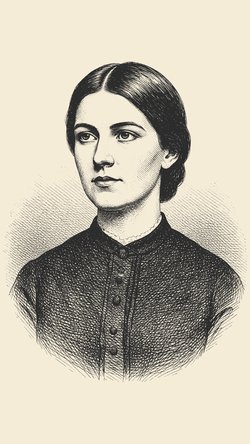
The McBriers were staunch Methodists and outspoken abolitionists. These convictions would carry through Fanny’s life and into the names she chose for her children. She was described as raven-haired and blue-eyed, a detail recorded by the Woolworth family historian Karen Plunkett-Powell.
Marriage Over Objections
On January 14, 1851, at age 20, Fanny married John Hubbell Woolworth in Pillar Point. The match displeased her father. Henry McBrier disapproved of John because the young farmer could not afford to hire a servant girl, a standard Henry considered essential for his daughter’s household. Fanny overruled her family’s protests and went ahead with the wedding.
The couple moved into a cottage on a hill on Jasper Woolworth’s 150-acre farm in Rodman, Jefferson County. John worked his father’s land. Fanny brought what records describe as “private means” independent of her husband, though John insisted on being the sole breadwinner. That independent money would prove important two decades later.
Two Sons on a Cold Farm
Frank Winfield Woolworth arrived on April 13, 1852, born in the cottage on Jasper’s farm. Four years later, on August 1, 1856, Fanny gave birth to a second son. She named him Charles Sumner Woolworth, after Charles Sumner, the Massachusetts senator who had been beaten nearly to death on the Senate floor two months earlier for his antislavery speeches. The name was a deliberate political statement from a family committed to abolition.
Around 1859, Jasper Woolworth sold the Rodman farm, and John and Fanny purchased 103.5 acres near Great Bend, New York, on the road to Champion. Life on the new property was hard work for the whole family. The boys milked cows before school and picked potatoes in the evening. A third child, daughter Flora M. Woolworth, was born around 1870.
Backing Frank’s Escape
Neither Frank nor Charles took to farming, but their father expected them to stay on the land. Around 1873, Fanny interceded. She convinced John to let Frank leave the farm and try his hand at commerce, a negotiation that required overcoming her husband’s deep skepticism of anything besides agriculture.
Then she put her own money behind the decision. From her personal savings, Fanny paid for Frank to attend bookkeeping classes at night school and gave him pocket money to survive his first three months away from the farm. Without her financial backing, Frank’s path into retail might never have started.
Five Days
On February 10, 1878, Frank opened a small store in Great Bend, working under the employment of Moore & Smith. Five days later, on February 15, Fanny died at the age of 47. She was buried at Sunnyside Cemetery in Great Bend, Jefferson County. Her mother Keziah had died just thirteen months earlier, on January 11, 1877.
Fanny did not live to see what her investment produced. Frank opened his first independent five-cent store in Utica, New York, on February 22, 1879, one year after her death. On November 6, 1880, her younger son Charles opened his own store at 125 Penn Avenue in Scranton, Pennsylvania, where he would live and work for 67 years. By 1912, the brothers’ separate chains merged into the F.W. Woolworth Company, a 596-store empire that became the largest retail operation in the world.
The Scranton Connection
Fanny McBrier never set foot in Scranton. She died in rural upstate New York two years before Charles arrived on Penn Avenue. Her connection to the city runs through the two sons she raised on that Jefferson County farm: Charles, who made Scranton his home for nearly seven decades and served as chairman of the Woolworth company, and Frank, whose name went on the door of thousands of stores worldwide. She funded their start, chose a name for her second son that broadcast her family’s values, and managed household finances that kept the family solvent through lean years on marginal farmland. John Woolworth remarried after her death and lived until 1907. The boys never went back to farming.
Timeline
1830-04-15
Born in Pillar Point, Jefferson County, New York, to Irish immigrants Henry McBrier and Keziah Sloan
1851-01-14
Marries John Hubbell Woolworth in Pillar Point, overruling her family's objections
1852-04-13
Son Frank Winfield Woolworth born in a cottage on Jasper Woolworth's farm in Rodman, NY
1856-08-01
Son Charles Sumner Woolworth born, named after the abolitionist U.S. Senator
1859
Family purchases 103.5-acre farm near Great Bend, NY
1870
Daughter Flora M. Woolworth born
1873
Intercedes with husband to let Frank leave the farm; funds his bookkeeping night school from her savings
1878-02-15
Dies at age 47 in Great Bend, five days after Frank opens a store there
Sources & Further Reading
- Childhood influences on the Woolworth Brothers, Woolworths Museum (2024)
- Fanny McBrier Woolworth (1830-1878), Find a Grave (2024)
- Francis (McBrier) Woolworth (1830-1878), WikiTree (2024)
- Charles Sumner Woolworth biography, Woolworths Museum (2024)
- Charles Sumner Woolworth, Grokipedia (2025)
- John Hubbell Woolworth (1821-1907), WikiTree (2024)
- 150 People Who Made Scranton Great: Charles Sumner Woolworth, Times-Tribune (2016)
- Frank Woolworth Biography, Woolworths Museum (2024)
- Remembering Woolworth's, Karen Plunkett-Powell (1999)
- F. W. Woolworth, Wikipedia (2024)