Biography
Farm Boy to Shop Clerk
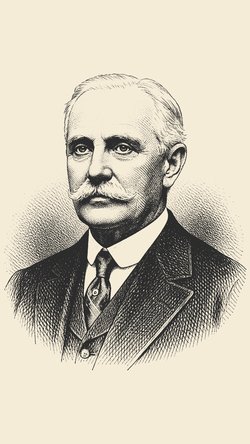
Frank Winfield Woolworth was born April 13, 1852, in a cottage on his grandfather Jasper Woolworth’s farm in Rodman, Jefferson County, New York. His parents, John Hubbell Woolworth and Fanny McBrier, raised him alongside his younger brother Charles, born in 1856. The boys grew up working the family farm in rural Jefferson County, and neither took to it.
Around 1868, at age sixteen, Frank finished his schooling and spent the next several years doing farmwork he disliked. His mother Fanny intervened around 1873, convincing his father to let Frank leave the land and funding a bookkeeping course at the Watertown Commercial College from her own savings. On March 24, 1873, Frank walked into Augsbury & Moore, a dry goods store in Watertown, New York, and began working as an unpaid apprentice. He proved inept behind the counter but showed a natural talent for arranging merchandise and dressing windows.
The Five-Cent Gamble
William Harvey Moore, co-owner of Augsbury & Moore, became Frank’s mentor in the dry goods trade. On February 22, 1879, with a $300 loan from Moore, Frank opened “Woolworth’s Great Five Cent Store” in Utica, New York. Every item in the store sold for a nickel. The concept drew crowds on opening day, but foot traffic dropped within weeks and the store closed.
Frank tried again four months later. On June 21, 1879, he opened a second store on North Queen Street in Lancaster, Pennsylvania, this time mixing in ten-cent merchandise alongside the five-cent goods. First-day sales hit $127.65. The Lancaster store held, and the five-and-ten model was born.
Scranton and the Birth of the “5 & 10”
Frank moved quickly to replicate the Lancaster success. He put his brother Charles in charge of a new store in Harrisburg, Pennsylvania, which opened July 19, 1879. That location struggled with a rent increase, and Frank relocated it to York, Pennsylvania, in March 1880. The York store lasted three months.
The next attempt proved different. On November 6, 1880, the brothers opened a store at 125 Penn Avenue in Scranton under a banner that read “5c & 10c Woolworth Bro’s Store.” Previous locations had been called “Five Cent” stores. Scranton was the first in the world to carry the combined “5 & 10” branding under a single name. Charles managed the store while Frank focused on expansion elsewhere.
The Scranton store was an immediate success. Charles had scouted the Penn Avenue location himself, choosing a space larger than needed and partitioning off the unused portion. Within a year or two, Charles bought out Frank’s share of the Scranton operation, becoming the chain’s first franchisee and establishing the C.S. Woolworth brand. Charles made Scranton his permanent home and base of operations for the rest of his life.
A Template Built in Scranton
What happened inside the Scranton store mattered as much as the sign above the door. Charles outfitted the space with mahogany counters divided by glass panels, glass-fronted showcases, bright lighting, and polished wooden floors. Customers could see and handle the merchandise without asking a clerk to retrieve it. The Penn Avenue store soon outgrew itself, and Charles moved to 319 Lackawanna Avenue, later expanding into the adjacent property at 317 Lackawanna Avenue. On December 8, 1900, Charles reopened the combined, remodeled store at 317-319 Lackawanna Avenue.
Frank recognized what his brother had built. He adopted the Scranton store’s layout, its display methods, and its self-service approach as the standard for all F.W. Woolworth stores. The merchandising formula that spread to hundreds and eventually thousands of locations had its roots on Penn Avenue and Lackawanna Avenue in Scranton.
Expansion Across Two Continents
By 1889, Frank operated twelve stores, and sales had increased 240 percent from his first full year in business. During the 1890s, he began traveling to Britain and Germany, buying directly from European factories to cut out middlemen and keep prices at or below the ten-cent ceiling.
By 1900, the chain had grown to 59 stores generating more than $5 million in annual sales. In February 1905, F.W. Woolworth & Company was formally incorporated. Four years later, Frank opened a subsidiary in Great Britain and placed his cousin Fred Moore Woolworth in charge of the overseas operation.
The 1912 Merger
By 1912, six separate five-and-ten chains had grown from the same original idea. Frank’s company operated 319 stores. His brother Charles ran 14 or 15 from Scranton. Fred Morgan Kirby, who had partnered with Charles on a Wilkes-Barre store back in 1884, controlled 96 locations. Seymour H. Knox, Frank’s cousin, had 98. E.P. Charlton contributed 35 and W.H. Moore added 2.
On January 31, 1912, the six chains merged into the F.W. Woolworth Company, valued at $65 million, with 596 stores under one corporate umbrella. Frank became president of the combined operation. Charles took a board seat and continued running his piece of the business from Scranton.
The Woolworth Building
The following year, Frank’s ambition took architectural form. The Woolworth Building opened in lower Manhattan in 1913, designed by Cass Gilbert. At 792 feet, it was the tallest building in the world and held that distinction until 1930. Frank paid the entire $13.5 million construction cost in cash, refusing to take out a mortgage.
War and Final Years
When the First World War cut off European suppliers who had provided roughly a quarter of Woolworth’s merchandise, Frank directed American factories to replicate the German and British goods his stores depended on. President Woodrow Wilson invited him to join a War Cabinet for government fundraising.
Frank married Jennie Creighton, a Canadian seamstress, on June 11, 1876. They had three daughters: Helena Maud, born in 1878; Edna, born in 1883; and Jessie May, born in 1886. Edna died in 1917 at 34. Frank’s granddaughter Barbara Hutton, Edna’s daughter, later became one of the most prominent American socialites of the twentieth century.
On April 8, 1919, Frank Woolworth died of septic shock from an infected tooth at his estate in Glen Cove, New York. He was five days short of his 67th birthday. An unsigned new will proved invalid, and an 1889 will left his entire estate to his wife Jennie. His net worth at death was approximately $76.5 million. The company he built operated more than a thousand stores and was valued at $65 million. Charles succeeded him as chairman of the board, a position he held from Scranton for the next 25 years.
Timeline
1852-04-13
Born in Rodman, Jefferson County, New York
1873-03-24
Begins unpaid apprenticeship at Augsbury & Moore dry goods store in Watertown, NY
1876-06-11
Marries Jennie Creighton
1879-02-22
Opens first store in Utica, NY; fails within weeks
1879-06-21
Opens store in Lancaster, PA; first successful five-and-ten
1880-11-06
Opens '5 & 10 Woolworth Bro's Store' at 125 Penn Avenue, Scranton, with Charles as manager
1905-02
F.W. Woolworth & Company formally incorporated
1912
Six chains merge into F.W. Woolworth Company with 596 stores; becomes President
1913
Woolworth Building completed in New York City, world's tallest building at 792 feet
1919-04-08
Dies of septic shock at his Glen Cove estate, five days before his 67th birthday
Sources & Further Reading
- Frank Winfield Woolworth, Wikipedia (2024)
- F. W. Woolworth Company, Wikipedia (2024)
- Charles Sumner Woolworth, Wikipedia (2024)
- Frank Woolworth Biography, Woolworths Museum (2024)
- Charles Sumner Woolworth biography, Woolworths Museum (2024)
- Woolworth's Five and Dime, Library of Congress (2024)
- Charles S. Woolworth House, SAH Archipedia (2024)