Biography
Connecticut Origins
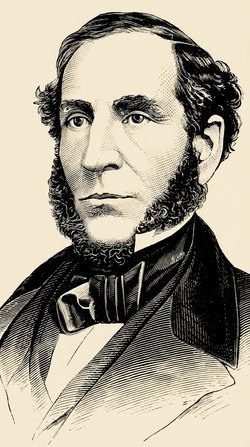
George Whitfield Scranton was born May 11, 1811, in Madison, New Haven County, Connecticut. His father Theophilus Scranton and mother Elizabeth Warner were both buried at West Cemetery in Madison. He attended local common schools and later Lee’s Academy before leaving Connecticut at seventeen.
In 1828, young Scranton moved to Belvidere, Warren County, New Jersey. He found work as a teamster hauling goods for eight dollars per month. Within a few years, he had advanced to mercantile work as a clerk and agent.
Learning the Iron Trade
By the early 1830s, Scranton was working at Oxford Furnace in Warren County, one of the older iron operations in the region. His younger brother Selden joined him there in 1834. The furnace was managed by William Henry, an innovative ironmaster who had achieved the first practical American use of hot blast furnace technology that same year.
The hot blast technique preheated air to at least 300 degrees before pumping it into the furnace through pipes called tuyeres. This Scottish innovation, developed in 1828, substantially lowered fuel needs. Henry improved on it further in 1835 by placing a hot blast oven atop the furnace stack, increasing production by nearly 40 percent.
When Henry left Oxford Furnace in 1837 to manage another operation, he left the Scranton brothers in charge. They gained firsthand experience running an iron operation and began considering opportunities elsewhere.
Marriage and Family
On January 15, 1835, George Scranton married Jane Hiles in Oxford, Warren County, New Jersey. Jane was born in 1811 and would outlive her husband by seventeen years, dying in 1878. She is buried alongside George at Dunmore Cemetery.
The couple had several children, including daughter Elizabeth Warner Scranton, born March 17, 1838, who later married G.A. Fuller. Sons included James Selden Scranton, who lived from 1841 to 1905. Another son, Joseph Scranton, was killed at the Battle of Roanoke Island on February 8, 1862, during the Civil War, just eleven months after his father’s death.
Arrival in the Lackawanna Valley
In July 1840, George and Selden Scranton arrived in the Lackawanna Valley with partner Sanford Grant. William Henry had been investigating the area since 1838, noting abundant deposits of anthracite coal, limestone, and iron ore along Roaring Brook. Henry lacked the capital to develop the site himself, so in 1840 he formed a partnership with his son-in-law Selden, George Scranton, and Grant.
They settled at Slocum Hollow, a hamlet consisting of five small houses, the Slocum house and barn, a grist mill owned by Barton Mott, a seven-by-nine schoolhouse, and a clattering saw mill. Another investor, Philip Mattes, also joined the venture. They named the firm Scrantons, Grant & Company.
The partners purchased 503 acres in the area. Construction of the first blast furnace began September 11, 1840. George Scranton served as on-site manager while the others secured financing and supplies.
Three Failed Attempts
The first year proved disastrous. On October 9, 1841, they attempted to light the furnace for the first time. Insufficient air pressure caused the tuyeres to become blocked with slag. The attempt failed.
On October 25, 1841, they tried again. The furnace ran only four days before shutting down. Problems plagued the operation: water levels in Roaring Brook dropped too low to power the bellows, charge mixtures proved unsuccessful, and the tuyeres kept clogging.
Facing potential ruin, the partners brought in John F. Davis, a Welsh ironmaker familiar with anthracite furnaces. Davis conducted repairs through the fall and winter. Finally, on January 18, 1842, the furnace achieved full operation. It produced 75 tons of pig iron before being shut down five weeks later for further improvements.
Near Bankruptcy and the Erie Contract
By 1846, the company teetered on the edge of bankruptcy. The furnace worked but produced mainly nails and basic iron products with limited profit margins. Cousin Joseph Scranton invested in the firm that year, saving it from collapse.
Facing financial ruin, the partners contemplated converting their nail mill into a rolling mill for railroad tracks. At the time, experienced Englishmen dominated world rail production. No American firm had manufactured T-rails at scale. All rails for American railroads had to be imported and shipped by sea from Great Britain.
The Scrantons learned that the New York and Erie Railroad held a contract with New York State to build a rail line 130 miles from Port Jervis to Binghamton. English suppliers were hesitating to fill the order. George and Selden traveled to New York and boldly persuaded the Erie’s board of directors to give their untested company a two-year contract for 12,000 tons of T-rails.
Benjamin Loder, president of the Erie Railroad, and industrialist William E. Dodge led a group of investors who advanced $90,000 to the firm. The Scrantons and Grant reorganized on November 7, 1846, as Scrantons and Platt.
Racing the Clock
Filling the contract required extraordinary effort. The company lacked a water route to the Erie line. The Scrantons had to draft dozens of teams of horses to carry finished rails scores of miles through wilderness and over mountains to New York, where the track was being laid.
Congress complicated matters by passing the Walker Tariff in 1846, lowering duties on imported rails from England. British competition intensified. But George Scranton welcomed the lower tariff for two reasons: his firm’s price of $65 per ton was already competitive with English prices, and the reduced tariff meant cheaper raw materials.
On December 27, 1848, just four days before the expiration of the Erie’s charter, the Scrantons fulfilled their contract. They became the first company in the United States to mass-produce T-rails. The achievement ended American dependence on England for railroad track.
Building the Lackawanna Iron & Coal Company
Success with the Erie contract transformed the operation. The company constructed three more anthracite furnaces between 1848 and 1852. By 1853, assets included four blast furnaces, a puddling mill for steel-making, a foundry, two blacksmith shops, two carpentry shops, a saw mill, a grist mill, company store, 200 dwellings, a boarding house, iron ore mines, coal mines, a tavern, and a hotel.
On March 11, 1853, the firm reorganized under special charter as the Lackawanna Iron and Coal Company with capital of $800,000, doubling its previous investment. Within a decade, the company would become the largest iron producer in the United States.
By 1865, four years after George’s death, the company had capacity to produce 60,000 tons of iron annually. By the 1880s, the furnaces ranked as the second largest iron producer in the nation, turning out 125,000 tons of pig iron yearly.
Founding a Town
As the iron works expanded, a town grew around it. The settlement went through several names. The original Slocum Hollow gave way to Harrison in 1845, honoring President William Henry Harrison. In 1850, residents renamed it Scrantonia in honor of the brothers.
George Scranton platted streets, sold lots, and donated land for churches and schools. In 1848, he supported the founding of the First Presbyterian Church on North Washington Avenue. He served as a Presbyterian deacon.
In 1851, the name was shortened to Scranton. George was 40 years old. Five years later, in 1856, the settlement incorporated as a borough. By then, the five-house hamlet of 1840 had grown into a thriving industrial community.
The Railroad President
Moving iron and coal to market required better transportation. George Scranton became the driving force behind building a railroad north from the Lackawanna Valley to connect with the Erie Railroad at Great Bend, Pennsylvania, near the New York border.
The Liggetts Gap Railroad had been chartered in 1832 but lay dormant for years. On April 14, 1851, it was renamed the Lackawanna and Western Railroad. The line opened December 20, 1851, running 51 miles north from Scranton to Great Bend. George Scranton served as its first president.
Meanwhile, the Delaware and Cobb’s Gap Railroad was chartered December 4, 1850, to build eastward from Scranton to the Delaware River. On March 11, 1853, the two companies consolidated as the Delaware, Lackawanna and Western Railroad. The DL&W would eventually connect Buffalo to Hoboken, becoming a major Class I railroad that transported anthracite coal to New York City markets.
Scranton served as DL&W president until 1858, when he left to pursue political office.
Congressional Career
In 1858, George Scranton won the Republican nomination for Pennsylvania’s 12th congressional district. He campaigned under the anti-slavery-extension banner and defeated his Democratic opponent with approximately 62 percent of the vote. The district had previously leaned Democratic, making his margin notable.
Scranton entered the 36th Congress on March 4, 1859. He served on committees related to manufactures and railroads, subjects he knew firsthand.
The 36th Congress proved one of the most contentious in American history. John Brown’s raid on Harper’s Ferry had occurred in late October 1858. His execution on December 2, 1859, inflamed sectional tensions. When Congress convened three days later, animosities ran high. Some members carried pistols and bowie knives into debates.
The election of a House Speaker required 44 ballots over two months. During the protracted contest, Scranton delivered a speech critiquing the Buchanan administration’s push for legislation protecting slave property in the territories. The Library of Congress preserves his remarks in a pamphlet titled “The Speakership: Speeches of Hon. George W. Scranton and Hon. James H. Campbell, of Pennsylvania, on the political questions of the day.”
In 1860, Scranton won re-election by an even larger margin. He would not complete his second term.
Death and Legacy
George Whitfield Scranton died in Scranton on March 24, 1861, at age 49. Health problems from overwork during the rugged 1840s had weakened him. He did not live to see the Civil War, which began three weeks later at Fort Sumter on April 12.
The war created enormous demand for iron and railroad equipment, exactly the products his company manufactured. The Lackawanna Iron & Coal Company thrived, eventually becoming the second-largest steel manufacturer in the world before merging with Bethlehem Steel in 1922.
Scranton is buried at Dunmore Cemetery. A cenotaph honoring him stands at Congressional Cemetery in Washington, D.C.
His wife Jane survived him by seventeen years. Their son Joseph died in combat eleven months after his father’s death. Cousin Joseph Scranton became president of Lackawanna Iron & Coal, serving until his own death in 1872.
The City He Built
At George Scranton’s death, the city he founded had approximately 9,000 residents. In 1866, five years later, Scranton incorporated as a city of 35,000 when it merged with the neighboring boroughs of Hyde Park and Providence. The 1870 census counted 35,092 residents.
By 1880, Scranton had grown to 45,850, ranking as the 39th most populous city in America, ahead of St. Paul, Denver, Oakland, and Atlanta. By 1900, population exceeded 102,000. The city George Scranton founded from a five-house hamlet had become the center of the American anthracite industry.
In 1878, Scranton became the seat of newly formed Lackawanna County, carved from Luzerne County. The Scranton family name would continue in Pennsylvania politics. Great-grandson William Warren Scranton served as Governor of Pennsylvania from 1963 to 1967 and sought the Republican presidential nomination in 1964.
Timeline
1811-05-11
Born in Madison, Connecticut to Theophilus Scranton and Elizabeth Warner
1828
Moves to Belvidere, New Jersey at age 17; works as teamster for $8 per month
1835
Marries Jane Hiles in Oxford, Warren County, New Jersey
1840-09-11
Begins construction of first blast furnace at Slocum Hollow
1841-10-09
First attempt to light the furnace fails; two more failures follow
1842-01-18
Furnace finally succeeds, producing 75 tons of pig iron before shutdown
1846
Secures contract with Erie Railroad for 12,000 tons of T-rails
1848-12-27
Completes Erie Railroad contract four days before deadline
1851
Settlement renamed Scranton; becomes president of Lackawanna & Western Railroad
1853-03-11
Company reorganizes as Lackawanna Iron & Coal Company with $800,000 capital
1856
Scranton incorporated as a borough
1858
Elected to U.S. Congress with 62% of the vote
1860
Re-elected to Congress by an even larger margin
1861-03-24
Dies in Scranton at age 49, three weeks before Civil War begins
Sources & Further Reading
- History of Luzerne, Lackawanna, and Wyoming Counties, Pa., W.W. Munsell & Co. (1880)
- A Brief History of Scranton, Pennsylvania, Cheryl A. Kashuba (2009)
- The Early History of the Lackawanna Iron and Coal Company: A Study in Technological Adaptation, Pennsylvania Magazine of History and Biography (1972)
- The Scranton Story, Burton W. Folsom Jr., The Freeman (1999)
- SCRANTON, George Whitfield, Biographical Directory of the United States Congress
- History of Oxford Furnace, Warren County, NJ Heritage Commission
- The Speakership: Speeches of Hon. George W. Scranton, Library of Congress (1860)