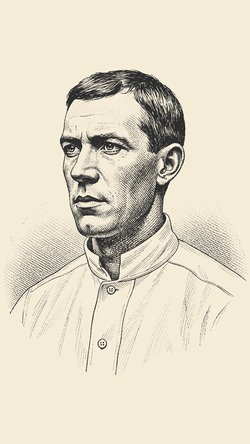
Biography
From Galway to Minooka
John Joseph O’Neill was born January 10, 1873, in Tawnaleen, a townland near Maum in County Galway, Ireland. His parents, Michael O’Neill and Mary Joyce, were farmers who had five children before the family left Ireland. Michael emigrated first to Pennsylvania, working several years in the coal regions to earn enough to bring the rest of the family across. By the 1880s, the O’Neills had settled in Minooka, a coal patch neighborhood on Scranton’s south side where three-quarters of the population claimed Irish descent.
The family eventually grew to 13 children, the last eight born in Minooka. Like most boys in the neighborhood, Jack went into the anthracite mines as a child, separating slate from coal for pennies a day. It was grueling, low-paying work that started as young as age six for some Minooka kids. Baseball offered something the breaker boys rarely got: a way out.
Five Seasons in the Mines of Minor League Ball
O’Neill spent approximately five seasons grinding through the minor leagues before reaching the majors at 29, an age when most catchers of his era were already past their prime. He debuted with the St. Louis Cardinals on April 21, 1902, and that first season carried a distinction no other player could claim. Jack caught while his brother Mike pitched, forming the first brother battery in major league history. To keep opposing batters from reading their signals, the O’Neill brothers called pitches to each other in Irish Gaelic.
His 1903 season was the best of his career. In 75 games behind the plate, Jack hit .236 with 23 runs, 58 hits, 9 doubles, 21 RBI, and 11 stolen bases. Scouts praised him as “a smart runner with some speed,” and he was frequently deployed as a pinch-runner. At one point during that season, observers considered him the best catcher in the National League.
Cubs and Beaneaters
After two years in St. Louis, O’Neill moved to the Chicago Cubs for the 1904 and 1905 seasons. He finished his career with the Boston Beaneaters in 1906, playing his final game on October 3. Over 303 career games, he posted a .196 batting average with 185 hits, 24 doubles, 5 triples, 1 home run, 74 RBI, and 20 stolen bases in 945 at-bats. The numbers were modest even by dead-ball era standards, but O’Neill’s value lived behind the plate, not at it. Catching in 1902 was as much about managing a pitching staff and controlling the running game as it was about hitting.
Back to Scranton
After his playing days ended, O’Neill returned to Minooka and took a job at the Keyser Valley shops of the Delaware, Lackawanna and Western Railroad. He also coached the Minooka Blues, the semipro team his eldest brother Pat had founded after a mining injury ended Pat’s own baseball prospects. Pat had never reached the majors, but he built something arguably more important. The Blues functioned as what some called “America’s first baseball school,” and Jack ran the club with a philosophy he called “inside ball for amateurs,” emphasizing fielding, pitching, bunting, and baserunning over power hitting.
The Blues played weekly games with $500 side bets riding on the outcome, plus whatever came through the gate. The roster read like a scouting report for major league front offices. Jack’s younger brothers Steve and Jim O’Neill both played for the Blues before reaching the majors, as did Mike McNally and Chick Shorten.
Four Brothers, One Game
The O’Neill family sent four brothers to the major leagues, a feat unmatched by any Irish immigrant family in baseball history. Mike O’Neill pitched for the Cardinals from 1901 to 1904 and the Cincinnati Reds in 1907, compiling a 32-44 record with a 2.73 ERA. On June 3, 1902, he hit the first pinch-hit grand slam in major league history, an inside-the-park shot. Steve O’Neill became the most accomplished of the four, catching 17 seasons for Cleveland, Boston, New York, and St. Louis before managing four clubs over 14 years. He hit .333 in the 1920 World Series and led the Detroit Tigers to the 1945 championship. His managerial record stood at 1,040 wins and 821 losses. Jim O’Neill, the youngest, played shortstop for the Washington Senators in 1920 and 1923, batting .287 with 43 RBI in 109 games.
In the 1920s, the brothers pooled their earnings and bought their mother a house. It was a long way from Tawnaleen.
Death
Jack O’Neill died on June 29, 1935, in Scranton. He was 62. He is buried at Saint Joseph’s Roman Catholic Cemetery in Minooka, the neighborhood that shaped him and his brothers into ballplayers.
Timeline
1873-01-10
Born in Tawnaleen, near Maum, County Galway, Ireland
1902-04-21
MLB debut with the St. Louis Cardinals at age 29
1902
Formed first brother battery in MLB history with pitcher Mike O'Neill
1903
Best major league season: .236 batting average, 75 games, 58 hits, 21 RBI, 11 stolen bases
1904
Traded to the Chicago Cubs
1906-10-03
Final major league game with the Boston Beaneaters
1935-06-29
Died in Scranton at age 62, buried at Saint Joseph's Cemetery in Minooka
Sources & Further Reading
- Jack O'Neill (baseball), Wikipedia (2025)
- Steve O'Neill, SABR BioProject (2025)
- A tribe called west: The forgotten Galway brothers who once ruled baseball, The42.ie (2015)
- Minooka, Pa. - Famous for Baseball, Minooka Memories (2012)
- Mike O'Neill (baseball), Wikipedia (2025)
- Steve O'Neill, Wikipedia (2025)
- Jim O'Neill (baseball), Wikipedia (2025)