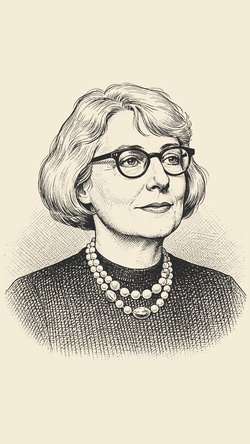
Biography
A Doctor’s Daughter
Jane Isabel Butzner was born in Scranton on May 4, 1916. Her father, John Decker Butzner, was a Virginia-born physician who ran a medical practice in the city and was active as a civic leader. Her mother, Bess Robison Butzner, was a former teacher and nurse whose family was tied to the coal-operating families of Hazleton. The Butzners were Protestants in a Scranton that was heavily Roman Catholic.
Jane grew up with a sister named Betty and a brother, John Decker Butzner Jr., who later sat on the U.S. Court of Appeals for the Fourth Circuit. In the 1910s the family lived on Electric Street in Green Ridge, then one of Scranton’s most prosperous residential neighborhoods.
1712 Monroe Avenue
The family later moved into a Georgian-style house at 1712 Monroe Avenue in Dunmore. When Jacobs published her first book, Constitutional Chaff, in 1941, she dedicated it to “1712 Monroe Avenue” rather than to any person.
As a young child she attended George Washington School No. 3 in Dunmore, and in 1928 she entered eighth grade at George Washington No. 1, a downtown Scranton “model school” housed in the School Administration Building. The route from Dunmore took her downtown by streetcar. After George Washington came Central High School in Scranton, where she served as poetry editor of the school magazine and earned the Girl Scout Eaglet rank.
Years earlier, in third grade, she had been expelled for clashing with her teacher. “I was an outlaw and I was accepting the fact that I was an outlaw,” she later said of the incident.
The City She Watched
Her father’s medical practice brought coal miners and factory workers through his exam rooms. Scranton had no zoning codes in those years, and as a child she watched industrial operations stand directly beside residential blocks.
Scranton ran the first electric streetcar system in America, inaugurated in 1886, and was nicknamed the Electric City. The city thrived on anthracite coal during the First World War and shifted toward manufacturing in the years that followed. Her biographer Glenna Lang has cited a serious car crash her father survived as one early influence on Jacobs’s later view that cars were not necessary in cities.
After High School
Jacobs briefly enrolled at the Powell School of Business and then took an unpaid position as assistant to the women’s page editor at the Scranton Tribune. The job was her first newsroom experience and lasted roughly a year before she left the city.
New York
In 1934, at eighteen, Jacobs left Scranton for New York City to join her sister Betty. She lived first in Brooklyn Heights and then in Greenwich Village. Decades later she wrote The Death and Life of Great American Cities and became one of the most influential American critics of postwar urban renewal.
The 1943 Article and the 1987 Letter
During the Second World War, Jacobs worked at Iron Age magazine in New York. In 1943 she wrote an article about Scranton’s economic decline that drew wide attention. The piece helped persuade the Murray Corporation of America to locate a warplane factory in Scranton, and Jacobs then petitioned the War Production Board to direct additional operations to the city. That same year, the Scranton Chamber of Commerce and the Scranton Tribune publicly thanked her for the economic boost.
In 1987 she wrote a letter opposing the destruction of part of Lackawanna Avenue for the development that became the Steamtown Mall.
Death and Marker
Jacobs died on April 25, 2006, at age 89. A stone marker on the grounds of the Lackawanna County Courthouse commemorates her ties to the city.
Timeline
1916-05-04
Born Jane Isabel Butzner in Scranton, Pennsylvania
1928
Enters eighth grade at George Washington No. 1 in downtown Scranton, riding the streetcar from Dunmore
1934
Leaves Scranton at age eighteen for New York City to join her sister Betty
1941
Publishes her first book, Constitutional Chaff, dedicated to 1712 Monroe Avenue
1943
Publishes Iron Age article on Scranton's economic decline; Murray Corporation locates a warplane factory in the city
1943
Scranton Chamber of Commerce and the Scranton Tribune publicly thank her for boosting the city
1987
Writes letter opposing demolition of part of Lackawanna Avenue for a shopping mall development
2006-04-25
Dies at age 89
Sources & Further Reading
- Jane Jacobs, Wikipedia (2024)
- The Life of Jane Jacobs's Hometown, City Journal (2021)
- Jane Jacobs Facts, Observe Scranton (2021)
- From the Ground Up, Brooklyn Rail (2016)
- Jane Jacobs, Encyclopaedia Britannica (2024)
- Scranton, PA: Walking in the Footsteps of Jane Butzner (Jacobs), Jane Jacobs Walk (2021)
- New Book: Jane Jacobs's First City, Viewpoint Vancouver (2021)
- Jane Jacobs, Project for Public Spaces (2008)