History
The Laurel Line
The Lackawanna and Wyoming Valley Railroad, known locally as the Laurel Line, began passenger operations on May 20, 1903. The 19-mile electric interurban line connected Scranton to Wilkes-Barre through the Wyoming Valley, running on 650-volt DC power fed through a third-rail system. Westinghouse Electric and Manufacturing Company financed the railroad and supplied its electrical equipment.
The original route into Scranton descended a steep grade from the heights of South Scranton down to the terminal near the DL&W passenger station. The grade slowed service and limited the size of trains the line could operate. Within a year of opening, the railroad’s engineers began planning a tunnel to bypass the problem entirely.
Construction
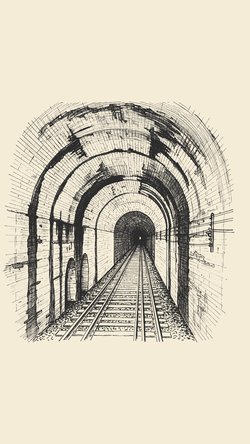
Westinghouse, Church, Kerr & Company, a subsidiary of Westinghouse Electric, won the contract to build the tunnel. Construction began in 1904 and proceeded from both ends simultaneously. Workers bored through bedrock beneath Crown Avenue in South Scranton, excavating a passage 4,747 feet long. The northern portal sits roughly 180 feet below the surface. The southern portal, closer to the Wilkes-Barre end, lies about 90 feet underground.
The project cost $500,000 and took approximately 18 months. The tunnel opened in October 1905, giving the Laurel Line a level, underground approach into its Scranton terminal. Third-rail electrification allowed trains to operate through the bore without the ventilation problems that plagued steam-powered tunnels elsewhere.
Peak Years
With the tunnel in service, the Laurel Line could run larger consists on tighter schedules. During the 1920s, the railroad carried up to 4.2 million passengers per year between Scranton and Wilkes-Barre. The line competed directly with the DL&W’s steam-powered service over the same corridor, offering faster and more frequent departures.
In 1914, Westinghouse interests sold their stake in the railroad. Under subsequent ownership, the Laurel Line continued passenger operations for nearly four more decades. The tunnel required minimal maintenance during this period. Its rock-cut walls and concrete lining proved durable under the constant vibration of electric traction motors.
Decline and Closure
Automobile ownership and highway construction eroded the Laurel Line’s ridership through the 1930s and 1940s. On December 31, 1952, the railroad ran its final passenger trains. The third-rail electrification was decommissioned the following year, and diesel locomotives took over for freight-only service through the tunnel.
The Delaware, Lackawanna and Western Railroad purchased the line in 1957, absorbing it into its regional freight network. When the DL&W merged with the Erie Railroad in 1960 to form Erie Lackawanna, the tunnel continued handling occasional freight movements. In 1976, the line was folded into Conrail during the reorganization of bankrupt northeastern railroads. Freight service ended shortly after, and the tunnel sat unused for roughly two decades.
Rehabilitation
In the late 1990s, Lackawanna County acquired the original right-of-way, including the tunnel. The bore had deteriorated during its years of abandonment. Water infiltration, crumbling masonry, and debris accumulation made it impassable.
Rehabilitation began in 2001. Workers repaired the tunnel lining, installed new drainage systems, replaced the trackbed, and re-electrified the passage with overhead catenary wire rather than the original third rail. The tunnel work alone cost over $3 million. The full restoration of the Laurel Line excursion route, including track, stations, and rolling stock, ran to nearly $6 million.
Phase two, covering electrification, was completed in August 2002. The Electric City Trolley Museum began operating tourist excursion rides through the tunnel that same month, using restored interurban cars running between the Steamtown National Historic Site and PNC Field.
Extension and Renaming
In 2006, a $2 million project added a 2,000-foot extension from the Steamtown NHS connection to a new trolley barn near the stadium. The extension gave the museum a dedicated maintenance facility and expanded the excursion route.
On a separate track, local historians and railroad preservation advocates campaigned to honor Edward S. Miller, a Pittston-based author and photographer who had documented the region’s railroads over a lifetime of work. Miller amassed more than 12,000 images of area rail operations before his death in 2010. In 2011, the tunnel was officially renamed the Edward S. Miller Memorial Tunnel. The original Crown Avenue Tunnel name remains in common use.
Current Operations
The Electric City Trolley Museum operates seasonal excursion rides through the tunnel, typically running from spring through fall. The route connects the Steamtown National Historic Site in downtown Scranton to the trolley barn near PNC Field, passing through the full length of the bore. At 4,747 feet, the tunnel ride takes several minutes in near-total darkness, broken only by the trolley’s headlamp and dim overhead lighting at intervals along the walls.
Sources & Further Reading
- Lackawanna and Wyoming Valley Railroad , Wikipedia (2024)
- Electric City Trolley Museum , Wikipedia (2024)
- Lackawanna and Wyoming Valley Railroad, 'The Laurel Line' , Adam Burns (2024)
- Railroad Tunnel Dedicated In Memory Of Ed Miller , Times Leader (2011)