History
Murchison’s Commission
By the early 1900s, the Delaware, Lackawanna and Western Railroad had outgrown its original brick passenger station on Lackawanna Avenue near Franklin Avenue, roughly seven blocks west of the present site. DL&W president William Haynes Truesdale, who took charge in 1899 and immediately began modernizing the railroad’s infrastructure, commissioned a replacement worthy of the company’s stature.
He hired Kenneth MacKenzie Murchison, a New York architect trained at Columbia University and the Ecole des Beaux-Arts in Paris. Murchison had already designed the DL&W’s Hoboken Terminal in New Jersey, and the Scranton station would be an enlarged variation on that same French Renaissance vocabulary. Ground was broken at 700 Lackawanna Avenue in September 1906.
Construction and Dedication
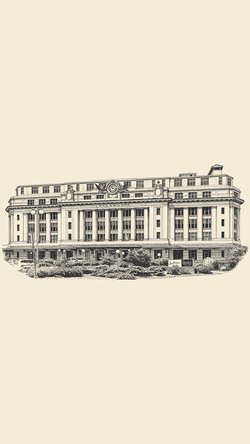
Fourteen months of construction produced a building that cost approximately $600,000. The structure rests on a steel frame clad in brick, with Indiana limestone sheathing the exterior and concrete forming the interior floors. Six prominent columns frame the main entrance beneath a 20-foot overhang, and an eight-foot bronze clock flanked by winged birds crowns the facade.
The station was officially dedicated on November 11, 1908. Architectural historian George E. Thomas later called it “the Lackawanna Valley’s primary City Beautiful monument.”
Interior
The grand waiting room rises two and a half stories to a barrel-vaulted ceiling of Tiffany leaded stained glass, with the DL&W’s initials worked into each corner. Walls of rare Siena marble surround the room, while Formosa marble, a pinkish-yellow Italian stone, faces the main entrance. The floor is ornamented mosaic tile.
Thirty-six tile panels produced by the Grueby Faience Company of Boston line the walls, each depicting a scene along the DL&W’s Phoebe Snow route from Hoboken to Buffalo. The panels were styled after paintings by Clark Greenwood Voorhees, an American Impressionist whose landscapes captured the valleys and ridgelines the railroad traversed. No two panels are alike.
The first floor originally held a lunch room, newsstand, telegraph office, ticket office, mail room, and baggage room, with railroad offices above. A sixth floor was added in 1923 to accommodate more office space.
Expansion and Early Alterations
In 1910, the old station site seven blocks west was demolished and replaced with a DL&W freight house capable of holding 100 railroad cars. A radio antenna went up on the station roof in 1914 for wireless communication, one of the earlier commercial installations in the region.
Decline
The DL&W merged with the Erie Railroad on October 17, 1960, forming the Erie Lackawanna Railway. Passenger traffic had been falling for years as automobile and highway travel drew riders away. On January 6, 1970, the last train pulled out of the station, and the building closed.
Erie Lackawanna declared bankruptcy in 1972 after Hurricane Agnes devastated its main line. The station sat empty for more than a decade, its marble walls darkening under a film of neglect while water seeped through the Tiffany ceiling.
Preservation and Hotel Conversion
The building was listed on the National Register of Historic Places on December 6, 1977, which shielded it from demolition but did nothing to arrest its deterioration. By the early 1980s, Scranton’s unemployment rate had climbed to 13 percent, and city officials were looking for anchor projects that could signal a downtown recovery.
Mayor James McNulty championed the station’s redevelopment. Private investors organized through the Chamber of Commerce purchased the building, and a $13 million package of federal, state, and municipal funds supplemented by private donations financed the conversion. Architect C. Robert Buchanan and Associates designed the transformation from terminal to hotel while preserving the lobby, tile murals, and stained-glass ceiling.
On New Year’s Eve 1983, the building reopened as The Hilton at Lackawanna Station with 146 guest rooms. The following year, it won a Design Honor Award from the Ohio chapter of the American Institute of Architects.
Later Ownership
DanMar Hotel Inc. purchased the property in 1993 for $4 million. Two years later, the hotel rebranded from Hilton to Radisson. In 2005, Akshar Lackawanna Station Hospitality LP acquired it for $7 million. A major renovation between 2007 and 2009 restored the Grueby Faience tile murals, which had suffered water damage and surface deterioration during the building’s years of abandonment.
Today
The Radisson Lackawanna Station Hotel operates 146 rooms at 700 Lackawanna Avenue. The bronze clock still marks time over the entrance. Guests check in beneath the same Tiffany stained-glass ceiling that once arched over travelers waiting for trains to Hoboken and Buffalo, and the 36 Grueby Faience panels still line the walls of what is now the hotel lobby.
Sources & Further Reading
- Scranton's Lackawanna Station Celebrated 100th Anniversary in 2008 , National Park Service (2008)
- Radisson Lackawanna Station Hotel , George E. Thomas (2012)
- Radisson Lackawanna Station Hotel , Clio (2024)
- Then and Now: DL&W Freight Station , Scranton Times-Tribune (2019)
- Lackawanna Station Hotel: A Repurposed in Scranton Success , Hotel Scoop (2024)