History
Thirty-Five Acres on the Hill
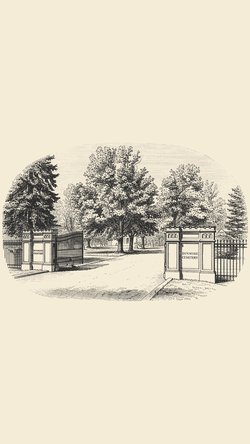
Dunmore Cemetery was established in 1828 on 35 hilly acres in Dunmore, Lackawanna County, more than three decades before the city two miles to its south incorporated and took the Scranton name. The Cemetery Association of Dunmore organized formally in 1864 to manage the property, and over the next century and a half the grounds filled with more than 25,000 burials. Forest Hill Cemetery sits adjacent, but Dunmore is the older and larger of the two.
A Sculpture Garden in Stone and Iron
What separates Dunmore from an ordinary burial ground is the density of its Victorian-era stonework. Ornate crypts, zinc memorials, and well-preserved ironwork line the paths that wind up and down the hills, broken here and there by a pyramid monument or a chapel. Near the entrance, a Receiving Vault with a grand domed roof, classical columns, and an ornate bronze door marks one of the property’s most photographed structures. The Boies family mausoleum, castle-like in its stonework with filigree metalwork visible through the entrance, has drawn comparisons to the monuments of Paris’s Pere Lachaise. Stained glass survives inside several of the mausoleums, including the Norton family’s.
Not every grave here belongs to a coal baron or iron magnate. The Cemetery Association donated burial space to the Home for the Friendless, a Scranton institution that housed the destitute, and the markers for those residents are nothing more than small unmarked stone squares laid flat in the grass.
George Scranton’s Monument
George Whitfield Scranton, co-founder of the Lackawanna Iron and Coal Company, is buried here beneath a monument his family and friends erected after his death in 1861. The inscription records that he was “of East Guilford, Connecticut, located in the Lackawanna Valley A.D. 1840” and became “the leading spirit in the inauguration and development of the great industries that have built up the City of Scranton.” He served two terms in Congress, and the “Colonel” on the monument was a sobriquet of deference rather than a military rank. His wife, Jane Hiles Scranton, is memorialized on the same stone.
The Valley’s Notable Dead
Walk the sections long enough and Dunmore starts to read like a directory of Lackawanna Valley power. Ezra Ripple, a Civil War survivor of Andersonville prison who later became mayor of Scranton, is buried a short distance from Isiah Everhart, founder of the Everhart Museum. George Catlin, whose home became headquarters of the Lackawanna Historical Society, rests nearby, as do the actress Marie Wainwright and former Scranton chief of police Lona Day.
Charles Sumner Woolworth, who opened his first five-and-ten-cent store on Penn Avenue in 1880 and built it into a national chain, lies in the Woolworth Mausoleum. Robert Nicholson, a member of the World War II special operations unit known as Merrill’s Marauders, is also interred here, one of many veterans whose graves span every American conflict from the Revolution forward.
Relocated Remains
Not all burials were original to the site. When the Washington Avenue German Lutheran Cemetery downtown was cleared, remains were moved to lot number 50 at Dunmore Cemetery and marked with a monument. Only a handful of individuals could be specifically identified in the transfer: Eising, Heckler, Klein, Lotz, and Rentchler.
The Dearly Departed Players
Each October, a theatrical group called the Dearly Departed Players brings the cemetery’s dead back to conversation. Julie Snell-Esty of Scranton founded and directs the troupe, which has been running two-hour walking tours on the first two Sundays of October since approximately 1999. The tours are free, require no reservations, and are sponsored by the Lackawanna Historical Society.
Fourteen performers dress in period costumes and station themselves along the route, portraying everyone from prominent Scranton industrialists to ordinary mine workers, with one stop dedicated to selections from Edgar Allan Poe. Local photographers and historical exhibits fill in the gaps between performances. In 2011, roughly 800 visitors walked the grounds over the two Sundays; by 2014 annual attendance had climbed above 1,500. COVID pushed the Players into virtual and drive-through formats for two years, and when they returned to in-person tours in 2022 nearly 700 attended. “We love doing it, we love portraying, we love bringing to life people that had lives,” performer Nelson Wood told Fox 56. “People forget.”
The group’s work has occasionally extended beyond the cemetery gates. In 2019, the Players assisted descendants of Merrill’s Marauders in their campaign for a Congressional Gold Medal. Esty herself has published three books drawn from her tour research, starting with “Stories in Stone: Tales of Life from the Dunmore Cemetery” in 2010.
The Cemetery Today
The Cemetery Association of Dunmore employs 14 people under superintendent Samuel Quinn and maintains an office on the grounds that sees steady traffic from visitors, genealogists, and families tending graves. Find A Grave lists 20,294 memorial records for the site, though the actual number of burials is higher. The cemetery can be reached at (570) 343-8536.
Sources & Further Reading
- Dunmore Cemetery and the Dearly Departed Players , Ed Snyder (2011)
- Dunmore Cemetery , Happenings Magazine (2014)
- Another Successful Season for Dearly Departed Players , The Dunmorean (2022)
- George Whitfield Scranton Monument , William Fischer Jr. (2017)
- Searching for Clues at the Dunmore Cemetery , Alison's Family History (2017)
- Dunmore Cemetery Showcases Lackawanna Valley History , Fox 56 News (undated)
- Cemetery Association of Dunmore , Cause IQ (2025)
- Dunmore Cemetery , Find A Grave (undated)
- Washington Avenue German Lutheran Cemetery Removals , Lackawanna PA GenWeb (undated)