History
The Founder
Dr. Isaiah Fawkes Everhart was born January 22, 1840, in Berks County, Pennsylvania, the youngest son of James and Mary Templin Everhart. He completed a four-year scientific course at Franklin & Marshall College before graduating from the University of Pennsylvania medical school during the 1862-63 academic year, just as the Civil War demanded surgeons. Everhart enlisted as an assistant surgeon in the 8th Pennsylvania Cavalry Regiment and was present at thirty battles, earning promotion to full surgeon with the rank of major on February 4, 1865. He mustered out on August 11, 1865, after serving as surgeon of the military district of Lynchburg, Virginia.
After an 1867 European tour, Everhart settled in Scranton as a practicing physician, joined the medical staff at Lackawanna state hospital, and served on the Scranton Board of Health. Alongside his medical work, he devoted decades to taxidermy and built one of the region’s finest private natural history collections from specimens of Pennsylvania’s birds and animals. An 1898 expedition through Mexico, the Pacific coast, and Alaska expanded it further. In 1905, he drafted a will designating funds for a museum in Nay Aug Park to house his specimens. A bronze statue honoring him was dedicated at the museum on May 20, 1911. He died five days later, at age 71.
The Building
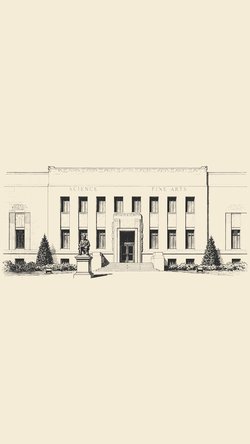
Architects Harvey J. Blackwood and John Nelson designed the museum in Beaux Arts style, drawing inspiration from the 1893 World’s Columbian Exposition in Chicago. Sited at the park entrance as an expression of the City Beautiful movement, it opened on Memorial Day 1908, Pennsylvania’s ninth museum and the first in the northeastern part of the state.
Everhart had envisioned three separate buildings forming three sides of a square, one each for natural history, science, and art. The trustees chose a different path. They commissioned architects David H. Morgan and Searle von Storch to add east and west wings to the original structure, creating an E-shaped footprint whose letter matched the founder’s name. The expansion replaced the Beaux Arts facade with Art Deco stripped classical detailing, and the enlarged building was dedicated on November 11, 1929, with 15 gallery spaces. A basement gallery for changing exhibitions followed in 1962, and during the 1980s the upper floor was renovated with climate control systems and an elevator.
Birds and Specimens
Everhart’s personal taxidermied bird collection formed the museum’s founding core, and within a dozen years the holdings had grown to 2,300 bird specimens, 400 mammals, 150 reptiles, and 800 minerals. Alfred Twining donated 2,100 botanical specimens in 1913, and in 1921 curator R.N. Davis led an expedition to Panama that extended the natural history collection beyond Pennsylvania’s borders.
The Bird Gallery today holds more than 700 specimens arranged in four dioramas depicting Pennsylvania habitats. Its birds include a passenger pigeon, a whooping crane, and an ivory-billed woodpecker. Many of the mounted specimens are ones Everhart prepared himself over a century ago.
Fossils and Minerals
The fossil collection draws on northeastern Pennsylvania’s deep geological history, with regional specimens from the Pennsylvanian Period, roughly 300 million years ago, preserved within the same anthracite coal deposits that built the city. The Fossil Gallery features artwork by Charles Robert Knight, whose reconstructions of prehistoric life defined the field in the early twentieth century.
Michael Roth’s 1991 donation of a fully articulated stegosaurus cast, nicknamed “Spike,” became one of the museum’s most recognizable exhibits, sharing gallery space with a Tyrannosaurus rex skull cast. The Weidlich Family added a 300-million-year-old Sigillaria trunk fossil in 2024. A fluorescent rocks and minerals case, first installed in 2008 and renovated in 2023, rounds out the geology holdings. Altogether the museum’s collection has grown to approximately 20,000 objects across natural history, science, and art.
Art and Ethnography
What began as a natural history museum shifted course in the 1930s when Executive Director Elizabeth Taylor steered the institution toward art, while Colonel Watres’s donation of Native American artifacts opened the door to ethnographic holdings. The John Willard Raught Memorial, established in 1931, houses the largest public collection of the Pennsylvania painter’s work, and over the next two decades folk art arrived through the generosity of John Law Robertson’s daughter Isabel R. Scott (1946-1948) and Priscilla Longshore Garrett. Julius Carlebach, a New York art dealer, broadened the museum’s geographic range with pieces from North Africa, the Mediterranean, and South America.
The Lackawanna Historical Society had shared the building since 1920 but relocated to the Catlin House in 1942, giving the museum room to grow. By the second half of the century, the collection spanned continents: 500 ancient Egyptian and Roman pieces, 4,000 ethnographic items, 500 African art objects, and Papua New Guinea artworks that arrived in the 1980s.
Dorflinger Glass
The museum’s relationship with Dorflinger Glass began in 1960 with an exhibition featuring tableware from the Lincoln White House. Christian Dorflinger had operated glassworks in White Mills and White Haven, Pennsylvania, from 1852 until 1921, producing crystal sought by eight successive presidents from Lincoln through Wilson. The Honesdale Decorating Company added colored finishes to Dorflinger pieces from 1901 to 1915.
Active acquisitions began in 1969, and a permanent gallery opened in 1973. The collection was reinstalled and the gallery reopened in 2023, spanning nearly fifteen centuries of glassmaking.
Contemporary Art
Hope Horn first exhibited at the museum in 1963, beginning a relationship that lasted decades and eventually moved outdoors when her sculpture “Redwing” was relocated to the grounds in 2019. Frederic C. Knight’s paintings entered the collection during his lifetime, with a substantial addition from his widow after his death in 1979. Michel Roux’s gifts in the 1990s brought Pop Art, Minimalism, and Abstract Impressionism into a museum that had started with stuffed birds, and acquisitions of Hunt Slonem and Margaret Evangeline paintings followed in 2017.
The Matisse Sale
The museum’s most contentious episode centered on Henri Matisse’s “Pink Shrimp,” donated in the 1960s by Adele Levy. When the board moved to sell it, curator Bruce Lanning refused the directive to ship the painting to Sotheby’s and lost his position in 2001. The museum sold it to a private buyer for approximately $1 million, placing the proceeds into its endowment. Dr. Everhart’s will had originally designated county judges as trustees, an arrangement the courts modified in the early 1990s to establish a community board.
The 2005 Theft
At approximately 2:30 AM on November 18, 2005, Thomas Trotta broke through the rear glass doors while Joseph Atsus and others waited outside. He took two paintings: Andy Warhol’s “Le Grande Passion,” a 1984 acrylic and silkscreen donated by Michel Roux in 1994, and Jackson Pollock’s “Springs Winter.” Police arrived four minutes after the alarm triggered. The thieves were already gone, the paintings on their way to Union, New Jersey.
The Warhol had been insured for $35,000 when acquired, though professional appraiser Leon Castner valued it at $125,000. The museum collected more than $100,000 in insurance for the Warhol but filed no claim for the Pollock, whose authenticity had never been verified. An insurance broker had deemed it a fake. The Everhart robbery turned out to be one stop in a larger operation that targeted 19 museums between 1999 and 2019. FBI agents arrested 10 men beginning in 2019. As of the 2025 federal trial, both paintings remain missing.
The Museum Today
A 2017 renovation restored the terrazzo floors and ceilings while installing modern track lighting, and Hope Horn’s “Angel Eye” sculpture, donated by Nivert Metal Supply Inc. in 2023, joined “Redwing” on the grounds. The museum operates as a nonprofit with more than a dozen galleries and programs including art workshops, a book club, and a senior arts club. Admission is free for SNAP, WIC, and EBT cardholders, as well as active and retired military families. Everhart’s taxidermied birds still watch from their cases on the first floor, many of them specimens he mounted himself before the building existed.
Sources & Further Reading
- History of the Everhart , Everhart Museum (2025)
- Everhart Museum , Wikipedia (2025)
- Isaiah Everhart , Wikipedia (2025)
- Natural History and Science , Everhart Museum (2025)
- Arts and Humanities , Everhart Museum (2025)
- Exploring the Everhart Museum in Scranton, PA , PA Bucket List (2025)
- Visit , Everhart Museum (2025)
- Everhart Museum curator takes stand in federal art heist trial , WVIA (2025)