History
From Reservoir to Public Ground
Mountain Lake began as part of the Pennsylvania Coal Company’s water system on East Mountain. The company bought the lake from Joseph Slocum for $175 on July 19, 1852, and used it as a reservoir for the steam engines on its gravity railroad. After the gravity line closed, the company sold the lake to John H. Jordan and associates in 1896. Mina Robinson purchased it from the Jordan group in 1898.
The lake already drew visitors before it became a city park. By the late 1890s, nearby groves offered bowling alleys, a shooting range, swings, bathhouses, fishing, swimming, and picnics. The Mountain Lake Hunting and Fishing Club organized in 1901, a decade before the land entered public ownership.
Mina Robinson’s Memorial Gift
In 1911, Robinson transferred Mountain Lake, access to East Elm Street, and more than 24 acres of East Mountain land to the City of Scranton. Her terms required the city to preserve and maintain the land and lake as a park. She named it Robinson Park in memory of her sons Edmund and Robert.
The gift created a permanent public place around a small lake that had passed through private and industrial ownership. The city accepted responsibility for ground that was distant from Scranton’s population center and difficult to reach, but already familiar to hikers, anglers, and East Mountain residents.
Building the Early Park
The city developed Robinson Park gradually. Charles Schumacher served as watchman from at least 1916 through 1934, followed by Fred Bonnert from 1934 through 1946 and John Warner beginning in 1946. A 1918 public works report recorded nearly 1,000 feet of seven-foot-wide walks, the clearing of underbrush, and the removal of trees killed by chestnut blight.
In 1927, the city described the park as a remote destination used mainly by hikers, fishermen, and winter skaters. Crews maintained the roads and built small wooden comfort stations, though the park still lacked an adequate water supply. Scranton added an artesian well in 1942 and an electric pump and pump house in 1943.
Camp Laurel, Fishing, and Skating
Mountain Lake became one of the park’s main attractions. Scranton’s Girl Scout council operated Camp Laurel there by the 1930s, with separate roped swimming areas and a floating dock. Marian Ford Rounds served as a nature counselor in 1936. The camp functioned mainly as a day camp, though girls also stayed overnight, including a group whose August 1945 session ended early when news arrived that World War II had ended. Camp Laurel moved to Roaring Brook Township around 1950.
Anglers also shaped the lake’s public life. On May 26, 1928, a state hatchery shipment brought 30,000 fish, including 13,000 walleyed pike and 15,000 yellow perch. Another 83,000 fish had been released the previous year. During the 1950s, crews cleared the whole lake for skating, drawing people from South Side, Petersburg, and the Hill Section as well as East Mountain.
Fred Bonnert’s years as watchman became part of the park’s winter memory. He kept a small lakeside shack with wooden benches and a potbelly stove where roughly 15 to 20 skaters at a time could warm themselves. By the 1970s, East Scranton and East Mountain hockey players competed on the ice.
New Facilities and Public Access
Scranton approved $182,768 in Community Development funds in 1977 and 1978 for a new recreation area used by the Lackawanna County chapter of the Pennsylvania Association for Retarded Citizens. The project added an activities building, parking, volleyball and basketball courts, and playground equipment. The grounds remained open to the general public.
East Mountain residents defended that public character in 1994. They opposed a proposal to relocate 960 feet of Mountain Lake Road so a private subdivision could create seven lakefront properties. Their campaign preserved public access to the city-owned lake. That same year, the East Mountain Improvement Association received $10,000 for playground equipment, while the city resurfaced the basketball court and installed new standards.
The lake required environmental work as well. Serious mine subsidence beneath its dam was repaired in 1988 with more than 200 cubic yards of concrete. During the 1990s, water lilies damaged the lake’s health until donated restoration work helped bring dissolved oxygen back to levels that could support fish.
The 2025 Renovation
Scranton completed a $1.1 million rebuilding project at Robinson Park in April 2025. Funding included a $481,600 state Community Conservation Partnerships Program grant, $502,884.50 in federal American Rescue Plan funds, and $141,078.06 from the city. Officials opened the finished work with a ribbon cutting on April 28.
The project installed accessible playground equipment and parking, refurbished multipurpose courts, paved a one-eighth-mile walking path, and improved stormwater drainage. Across Mountain Lake Road, an accessible fishing dock and kayak launch opened the water to more visitors. These additions answered a recommendation in Scranton’s 2021 parks assessment for better access to Mountain Lake.
Robinson Park Today
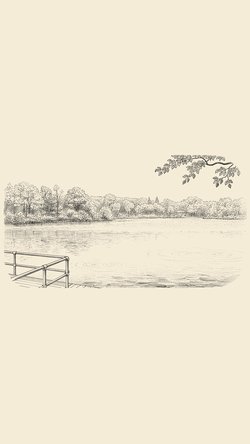
Robinson Park covers 30.42 acres, making it Scranton’s second-largest municipal park after Nay Aug. Mountain Lake is the only lake contained within a city park. Mountain Lake Road divides the playground, courts, and walking path from the lake, dock, and kayak launch.
The park still follows the purpose Mina Robinson set in 1911: publicly maintained land and water reserved for recreation. Its uses have changed from long walks, fishing clubs, crowded skating sessions, and scout camps to accessible play areas, pickleball, kayaking, and fishing from a modern dock.
Sources & Further Reading
- Mountain Lake, Scranton , Donna Adler (2011)
- Scranton Celebrates $1.1 Million Robinson Park Project , City of Scranton (2025)
- Scranton unveils $1.1 million upgrade at Robinson Park, enhancing local outdoor recreation , FOX56 News (2025)