History
Origins at Slocum Hollow
In August 1840, a small group of investors stood at the edge of Roaring Brook in a backwater called Slocum Hollow. The settlement contained exactly five houses, a schoolhouse, a gristmill, a sawmill, a cooper shop, and the Slocum family home. What caught their attention was not what existed above ground, but what lay beneath it: abundant outcroppings of anthracite coal, iron ore, and limestone within walking distance of each other.
William Henry, a New Jersey speculator and ironmaker, had been scouting the Lackawanna Valley since 1838. At the Oxford Furnace in Warren County, New Jersey, he had become the first American to successfully apply hot-blast technology to iron smelting in 1835. His son-in-law Selden Scranton and brother George Scranton owned that same Oxford Furnace. Together with Sanford Grant of Belvidere, New Jersey, and Philipp Mattes, an Easton bank manager, they formed Scranton, Grant & Company.
Henry purchased 503 acres along Roaring Brook. On September 11, 1840, workers broke ground on a blast furnace.
The Failed First Attempt
The furnace was completed in early autumn 1841. It did not work.
The problems were numerous. The furnace could not reach smelting temperatures. Water levels in Roaring Brook ran too low to power the waterwheel-driven bellows. Experiments with different mixtures of ore, coal, and limestone failed repeatedly. The tuyeres—openings that inject air into the furnace—kept clogging.
The partners tried everything. They burned wood and charcoal alongside the anthracite. They added salt and brimstone to intensify the heat. Nothing produced usable iron. The investors had sunk their capital into a hole in the ground that would not function.
George Scranton recruited John F. Davis, a Welsh ironworker who understood anthracite furnaces. Davis had the practical knowledge the partners lacked. Under his direction, workers enlarged the hot-air ovens, modified the machinery, and adjusted the charge mixtures.
On January 18, 1842, the furnace fired successfully. It produced 75 tons of pig iron before shutting down five weeks later for repairs. The experiment had worked.
Building the Permanent Furnaces
The early furnace was an improvised affair, adequate for proving the concept but not for industrial-scale production. Between 1848 and 1857, the company constructed four massive stone blast furnaces that would define the site.
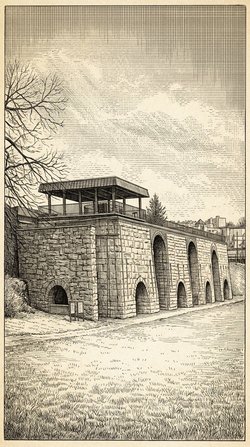
Each furnace stood approximately 40 feet high, built from locally quarried stone with refractory brick linings capable of withstanding the intense heat of continuous smelting. The arched openings at the base connected to bellows, casting beds, and material handling systems. Raw materials entered from the top; molten iron and slag flowed from the bottom.
Furnace No. 1 was completed in 1848. Furnace No. 2 followed in 1849. Furnace No. 4 came online in 1852. Furnace No. 5, the last, was finished in 1857 and “ganged”—linked to the other furnaces to share hot blast machinery.
In 1854, the company installed two double-connected lever-beam steam engines to power the blowing cylinders. These were the largest such engines in the United States. They eliminated dependence on the unreliable waterwheel and allowed year-round operation regardless of creek levels.
The Erie Railroad Contract
The contract that transformed the company arrived in 1846. The New York and Erie Railroad faced bankruptcy. The state of New York had offered to release a $3 million claim if the railroad completed its line to Binghamton by the end of 1848. The task seemed impossible because the railroad could only obtain iron rails from England, and English rails cost too much and took too long to deliver.
George Scranton negotiated directly with the railroad. He offered to deliver domestically produced T-rails—something no American company had done at scale. The initial contract called for 4,000 tons at $65 per ton. When Scranton delivered, a second contract followed for 12,000 tons.
The company had never manufactured T-rails. Scranton brought machinery from Philadelphia and built a rolling mill alongside the furnaces. On July 23, 1847, the first iron T-rails rolled off the line.
Rail production began in August 1847, and by year’s end the company employed more than 800 workers. Through the winter of 1847-48, crews hauled rails overland through snow to meet the railroad. On December 27, 1848—just four days before the Erie’s charter would have expired—Scranton, Grant & Company fulfilled its contract.
The Erie Railroad survived. Scranton had become the first company in the United States to mass-produce T-rails.
The Workforce
The furnaces operated around the clock in 12-hour shifts. The work was dangerous, exhausting, and hot. Molten iron and slag posed constant burn hazards. Falls, crushing injuries, and heat-related illness were common.
The earliest workers were predominantly Welsh, Irish, and German immigrants. Welsh ironworkers brought crucial expertise from the coal districts of Britain. Many had worked in and around mines for years before emigrating, and they moved quickly into the most skilled and supervisory positions.
Irish laborers, many fleeing the potato famine, supplied much of the manual labor. In 1851, the Scrantons built the Lackawanna and Western Railroad northward to connect with the Erie at Great Bend, using predominantly Irish work crews.
By 1847, the company employed 800 workers. As the decades passed and production expanded, the workforce grew. At its peak in the 1890s, the combined Lackawanna Iron and Steel operation employed over 5,000 men.
Growth and Reorganization
In 1853, the partners reorganized their company as the Lackawanna Iron and Coal Company, doubling capital investment to $800,000. Selden Scranton became president. Within a year, company assets had expanded to include three furnaces, rolling and puddling mills, a foundry, two blacksmith shops, two carpenter shops, a car shop, a sawmill, a grist mill, offices, a company store, a boarding house, a hotel, a tavern, 200 houses for workers, and mines for both ore and coal.
George W. Scranton, the driving force behind the Erie contract, did not live to see the company reach its peak. He died on March 24, 1861, at age 49, after serving two terms in Congress as a Republican. The town that had grown around his furnaces—renamed Scranton in his honor in 1851—already had a population in the thousands.
By 1865, Lackawanna Iron and Coal had the capacity to produce 60,000 tons of iron annually, more than any other facility in the United States. In the 1860s, it was the nation’s second-largest ironworks.
The Bessemer Era
The original furnaces produced pig iron, which was further refined in puddling furnaces and shaped in rolling mills into rails and other products. This process was labor-intensive and limited in scale. The Bessemer process, invented in England in 1855, offered a faster and cheaper method for producing steel.
William Walker Scranton, a second-generation manager, traveled secretly to Britain and Germany to learn the Bessemer technique firsthand. He worked as a puddler in European mills to understand the process from the inside. Returning to Scranton, he spent years convincing his business partners to invest in the new technology.
The first Bessemer “blow”—the pouring of molten steel from a Bessemer converter into molds—occurred at the Scranton works on October 23, 1875. The first Bessemer steel rolled through the mill on December 29, 1875. Production capacity quadrupled.
Peak Production
By 1880, the furnaces produced 125,000 tons of pig iron annually. The rolling mills and foundry converted this output into T-rails and other products.
In 1891, Lackawanna Iron and Coal merged with Scranton Steel Company to form Lackawanna Iron and Steel Company, the third-largest steelworks in the nation. By 1894, the combined operation employed 3,000 workers and manufactured 500,000 tons of steel rail—one-sixth of national output.
The company’s two six-ton Bessemer converters could produce 250,000 tons of steel ingots per year. The rolling mills processed 220,000 tons of steel rails annually.
The Move to Buffalo
Several forces combined to end iron and steelmaking in Scranton. The high-grade iron ore deposits of Minnesota’s Mesabi Range, discovered in the 1880s, offered superior raw material. But Scranton sat far from the Great Lakes shipping routes that connected Mesabi ore to markets in the Midwest.
Labor costs were rising. The United Mine Workers organized most workers at the coal and iron mines in 1897. A successful strike in 1900 won a 10 percent wage increase. A second strike from May to October 1902 brought another raise and improved conditions.
Shipping iron ore to Scranton had become increasingly expensive. Rail connections from Scranton to emerging midwestern markets were inadequate.
On March 23, 1899, company executives met in Buffalo to discuss relocating. They chose an undeveloped shoreline on Lake Erie in the Town of West Seneca. Land purchases began April 1, 1899, and the company acquired nearly all required property for $1.1 million.
On February 14, 1902, the company reorganized as Lackawanna Steel Company. It was the largest independent steel company in the world. The move stimulated the founding of a new city in New York, named Lackawanna after the Pennsylvania county the company left behind.
Beginning in 1901, workers dismantled the Scranton mills. The blast furnaces fell silent after more than sixty years of continuous operation. By 1902, the relocation was complete.
Preservation
The four stone blast furnaces survived because they were too massive and too expensive to demolish completely. They stood abandoned for decades, slowly deteriorating.
In the late 1960s, the state of Pennsylvania acquired the property. The Pennsylvania Historical and Museum Commission took control in 1971, recognizing the site’s significance to industrial history.
On September 6, 1991, the furnaces were listed on the National Register of Historic Places as the Lackawanna Iron and Coal Company Furnace. The site is now part of the Pennsylvania Anthracite Heritage Museum complex.
Today
The four furnaces stand open to the public from dawn to dusk throughout the year. The massive stone structures remain largely intact, their arched openings and weathered walls conveying the scale of 19th-century ironmaking.
The Pennsylvania Anthracite Heritage Museum, located nearby in McDade Park, operates interpretive programs at the site. Visitors can walk among the furnaces, examine the construction methods, and trace the outlines of the casting beds and charging ramps that once fed the operation.
The furnaces are the largest surviving anthracite ironmaking complex in the United States. They stand as physical evidence of the era when Scranton produced more iron than any other place in America.
Sources & Further Reading
- Lackawanna Iron and Coal Company Furnaces , Society of Architectural Historians (2017)
- Scranton Iron Furnaces , Pennsylvania Historical and Museum Commission (2024)
- Iron Furnaces , Pennsylvania Anthracite Heritage Museum (2024)
- Scranton Iron Furnaces Historical Marker , Historical Marker Database (2024)
- Lackawanna Steel Company , Wikipedia (2024)
- The Scranton Story , Foundation for Economic Education (1950)
- History of Lackawanna Valley: Scranton , Lackawanna County PAGenWeb (2024)